
An Indian LLP can accept foreign investment, but under narrower rules than a company. This guide to FDI in LLP India sets out when it is allowed, how the contribution is priced and reported on the RBI’s FIRMS portal, and how an LLP compares with a private company for foreign investors. It is based on the FEMA (Non-debt Instruments) Rules, 2019 and published sources as of 31 October 2026. For FEMA advice on your own structure, see our FEMA advisory page.
- Automatic route only. Sectors that need approval, carry a cap below 100% or have FDI-linked performance conditions are closed to LLPs.
- Not eligible to invest: citizens and entities of Pakistan or Bangladesh, FPIs and FVCIs.
- Fair price is a floor on entry and a ceiling on exit to a resident. Payment is by inward remittance or from an NRE or FCNR(B) account.
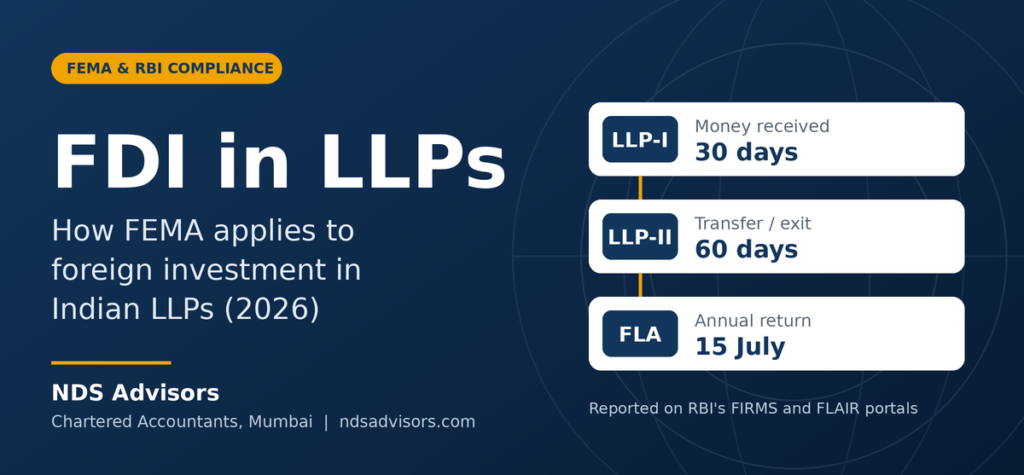
- Forms: LLP-I within 30 days of receipt, LLP-II within 60 days, FLA by 15 July, all after setting up the FIRMS entity master.
- Conversion between a company and an LLP is automatic only in the same open sectors.
When Can an LLP Accept Foreign Investment?
The test is the sector. If the LLP’s activity sits in a 100% automatic-route sector with no FDI-linked performance conditions, it can take foreign money. If not, it cannot, and there is no approval route to fall back on.
Check the investor, price and payment rules, then report in Form LLP-I.
Consider a private company, within its caps, routes and conditions.
| Condition | Rule |
|---|---|
| Sector | 100% FDI allowed under the automatic route, with no FDI-linked performance conditions |
| Route | Automatic only; there is no approval route for LLPs in other sectors |
| Investors | Persons resident outside India, NRIs and OCIs; not citizens or entities of Pakistan or Bangladesh, FPIs or FVCIs |
| Form of investment | Capital contribution, or acquisition of a profit share |
| Payment | Inward remittance through banking channels, or debit to the investor’s NRE or FCNR(B) account |
| Pricing | Not less than the fair price on investment; not more than the fair price on exit to a resident |
Who Can and Cannot Invest in an LLP?
Persons resident outside India, including NRIs and OCIs, can invest if the sector condition is met. Four groups cannot:
- Citizens of Pakistan
- Citizens of Bangladesh
- Entities from those countries
- FPIs and FVCIs
An investor with beneficial ownership in a country that shares a land border with India should check whether government approval is needed. Press Note 2 of 2026 on land-border beneficial ownership is one of the points to watch (see the last section).
Which Sectors Are Closed to Foreign-Invested LLPs?
Because of the sector condition, an LLP cannot take FDI where a company could only do so with a cap, an approval or a performance condition. Commentators list these among the sectors effectively closed to LLPs:
- Agriculture, animal husbandry and plantations
- Mining
- E-commerce
- Wholesale trading
- Single-brand retail trading
- Construction development
- Greenfield pharmaceuticals
- Other financial services
Sectors commonly used by foreign-invested LLPs include:
- Software development
- IT-enabled services
- Business consultancy
Whether a condition counts as “FDI-linked” is not always clear, so check the sector against the current consolidated FDI policy before accepting money. Our FEMA advisory page lists the support available for this check.
How Is a Foreign Partner’s Contribution Priced?
The contribution or profit share must be acquired at not less than its fair price, worked out under an internationally accepted valuation method. A Chartered Accountant, a practising Cost Accountant or an approved valuer from the Central Government’s panel certifies it. On a transfer from a non-resident to a resident, the price must not exceed the fair price. The money must come through a banking channel, by inward remittance or from the investor’s NRE or FCNR(B) account.
Which RBI Filings Apply to an LLP?
All reporting is done online. Before the first filing, the LLP registers an entity master on FIRMS using its LLPIN and appoints a business user. The LLP-I clock runs from the date the money is received, not from the date the LLP agreement is amended.
| Event | Form | Deadline | Filed through |
|---|---|---|---|
| Capital contribution or profit share received from a non-resident | LLP-I (FEMA Form I for LLPs) | 30 days from receipt of the money | FIRMS |
| Transfer between resident and non-resident; disinvestment | LLP-II (FEMA Form II for LLPs) | 60 days from receipt of funds | FIRMS |
| Downstream investment by a foreign-invested LLP | DI | 30 days from the investment | FIRMS |
| Annual foreign liabilities and assets | FLA return | 15 July each year | FLAIR |
| Investment by the LLP in an overseas entity | Form FC; APR (overseas direct investment) | At the time of investment; 31 December each year | AD bank |
Form LLP-I (FDI-LLP(I)) is filed with the bank’s FIRC and KYC, the valuation certificate and a declaration from a designated partner. Form LLP-II (FDI-LLP(II)) is filed with the remittance proof, KYC, valuation certificate and consent letters. An LLP that has received foreign capital contribution in the current or an earlier year files the FLA return every year. Mark the dates in the compliance calendar.
How Do You Report Foreign Investment in an LLP, Step by Step?
- Check the sector against the current consolidated FDI policy: 100% automatic route, no FDI-linked performance conditions.
- Check the investor. Citizens and entities of Pakistan or Bangladesh, FPIs and FVCIs are not eligible.
- Get the fair price certified by a Chartered Accountant, Cost Accountant or approved valuer.
- Receive the money through banking channels, by inward remittance or from an NRE or FCNR(B) account, and collect the FIRC and KYC.
- Register the entity master on FIRMS with the LLPIN and appoint a business user.
- File Form LLP-I within 30 days of receiving the money, with the declaration from a designated partner.
- File the FLA return by 15 July each year while the LLP holds foreign capital.
LLP or Private Company: What Changes for Foreign Investors?
The two structures differ on sectors, instruments and reporting. For companies, the matching reports are FC-GPR, FC-TRS and FLA; see our FC-GPR filing page.
| Point | LLP | Private limited company |
|---|---|---|
| Sectors open | Only 100% automatic-route sectors without FDI-linked conditions | All permitted sectors, within caps, routes and conditions |
| Instruments | Capital contribution and profit share | Equity, CCPS, CCDs, warrants; convertible notes for DPIIT-recognised startups |
| Employee equity | No ESOPs under the Companies Act | ESOPs under Rule 12 |
| Share swaps and deferred consideration | Not available, according to commentators | Permitted, subject to conditions |
| Reporting | LLP-I, LLP-II, FLA | FC-GPR, FC-TRS, FLA |
| Resident requirement | At least one designated partner resident in India | At least one director resident in India (182 days in the financial year) |
Can a Foreign-Invested LLP Invest Elsewhere, Issue Convertibles or Raise ECB?
Downstream investment. An LLP with foreign investment can invest in another company or LLP, but only in a sector where 100% FDI is allowed under the automatic route with no FDI-linked performance conditions. The investee is responsible for checking compliance, and the LLP reports it in Form DI within 30 days.
Convertible instruments. An LLP cannot issue shares, CCPS, CCDs, convertible notes or ESOPs, because these are company instruments.
ECB. The framework that took effect on 16 February 2026 allows any resident entity (other than an individual) set up under a law that permits it to borrow. Commentators read this as including LLPs, but confirm eligibility with the AD bank.
Can a Foreign-Invested LLP Convert into a Company?
- LLP to company: allowed under the automatic route if the LLP is in a sector where 100% FDI is allowed under the automatic route with no FDI-linked performance conditions. The conversion follows Part I of Chapter XXI of the Companies Act, 2013.
- Company to LLP: allowed under the automatic route on the same sector condition.
- Before converting: obtain a fresh valuation, settle partners’ consents and the share allotment ratio, and confirm with the AD bank how the converted foreign holding is reported.
- Tax: the exemption for conversion of a company into an LLP, and its conditions, are separate from FEMA; check them under the Income-tax Act, 2025.
What Should LLPs Watch Into 2027?
- The Corporate Laws (Amendment) Bill, 2026 (introduced 23 March 2026; Joint Parliamentary Committee report 3 August 2026). It would apply the registered valuer framework under section 247 of the Companies Act to LLP valuations, including partner contributions. It is not yet law.
- Beneficial ownership. How the May 2026 NDI amendment and Press Note 2 of 2026 on land-border beneficial ownership are applied to LLP investors.
- Alignment with companies. Any move to align LLPs with companies on sectors, share swaps or non-cash consideration, which practitioners have asked for.
What Are the Most Asked Questions About FDI in LLPs?
Can an LLP in India receive foreign investment?
Yes. Under the FEMA (Non-debt Instruments) Rules, 2019, an LLP can receive foreign investment under the automatic route if it operates in a sector where 100% FDI is allowed under the automatic route and there are no FDI-linked performance conditions. The investment can be a capital contribution or the acquisition of a profit share.
Which sectors are closed to FDI in LLPs?
Any sector with FDI-linked performance conditions, any sector capped below 100% under the automatic route, and any sector that needs government approval. Commentators list agriculture and plantation, mining, e-commerce, wholesale and single-brand retail trading, construction development and other financial services among the sectors that are effectively closed to LLPs. Check the sector against the current consolidated FDI policy.
Who cannot invest in an LLP?
Citizens of Pakistan or Bangladesh, entities incorporated in those countries, Foreign Portfolio Investors and Foreign Venture Capital Investors cannot invest in an LLP. Other persons resident outside India, including NRIs and OCIs, can invest if the sector condition is met. Investors with beneficial ownership in a country sharing a land border with India should check whether government approval is needed.
How is the price of a foreign partner’s contribution worked out?
The contribution or profit share must be acquired at not less than its fair price, worked out under an internationally accepted valuation method. A Chartered Accountant, a practising Cost Accountant or an approved valuer from the Central Government’s panel certifies it. On a transfer from a non-resident to a resident, the price must not exceed the fair price.
What is Form LLP-I and when is it due?
Form LLP-I (FDI-LLP(I)) reports foreign investment received by an LLP as capital contribution or for a profit share. It is filed on the RBI’s FIRMS portal within 30 days of receiving the money, with the bank’s FIRC and KYC, the valuation certificate and a declaration from a designated partner.
What is Form LLP-II?
Form LLP-II (FDI-LLP(II)) reports a disinvestment, or a transfer of capital contribution or profit share between a resident and a non-resident. It is filed on FIRMS within 60 days of the receipt of funds, with the remittance proof, KYC, valuation certificate and consent letters.
Does an LLP with foreign investment file the FLA return?
Yes. An LLP that has received foreign capital contribution in the current or earlier years files the annual return on Foreign Liabilities and Assets on the RBI’s FLAIR portal by 15 July each year.
Can a foreign-invested LLP invest in other Indian entities?
Yes. An LLP with foreign investment can make downstream investment in another company or LLP, but only in a sector where 100% FDI is allowed under the automatic route with no FDI-linked performance conditions. The investee is responsible for checking compliance.
Can an LLP with foreign investment convert into a company?
Yes, under the automatic route, if the LLP is in a sector where 100% FDI is allowed under the automatic route with no FDI-linked performance conditions. The same condition applies to a company with foreign investment converting into an LLP. Conversion of an LLP into a company is done under Part I of Chapter XXI of the Companies Act, 2013; confirm the RBI reporting of the converted holding with the AD bank.
Can an LLP issue convertible instruments or raise ECB?
An LLP cannot issue shares, CCPS, CCDs, convertible notes or ESOPs, because these are company instruments. On ECB, the framework that took effect on 16 February 2026 allows any resident entity (other than an individual) set up under a law that permits it to borrow; commentators read this as including LLPs, but confirm eligibility with the AD bank.
The bottom line
An LLP can take foreign investment only in 100% automatic-route sectors with no FDI-linked performance conditions, at or above the fair price, and with Form LLP-I filed within 30 days of receipt. Transfers go in Form LLP-II within 60 days, and the FLA return falls due every 15 July. A business that expects convertible instruments, ESOPs or priced rounds usually needs a company, and a closed-sector investment cannot be cured by a late filing.
For queries
NDS Advisors, Chartered Accountants, Andheri (East), Mumbai, advises businesses on company law, FEMA, income tax, GST and compliance. For questions, write to info@ndsadvisors.com, call +91 91670 58000, or see our contact page. This article is for general information only and is not professional advice or a solicitation of work.
Written by the team at NDS Advisors
NDS Advisors is an ICAI-registered firm of Chartered Accountants in Andheri (East), Mumbai, advising individuals and businesses on income tax, GST, audit, company law and compliance.
Related pages: FEMA Advisory · FLA Return Filing · FC-GPR Filing · Overseas Direct Investment · NRI Tax Filing · Compliance Calendar · All blog posts