
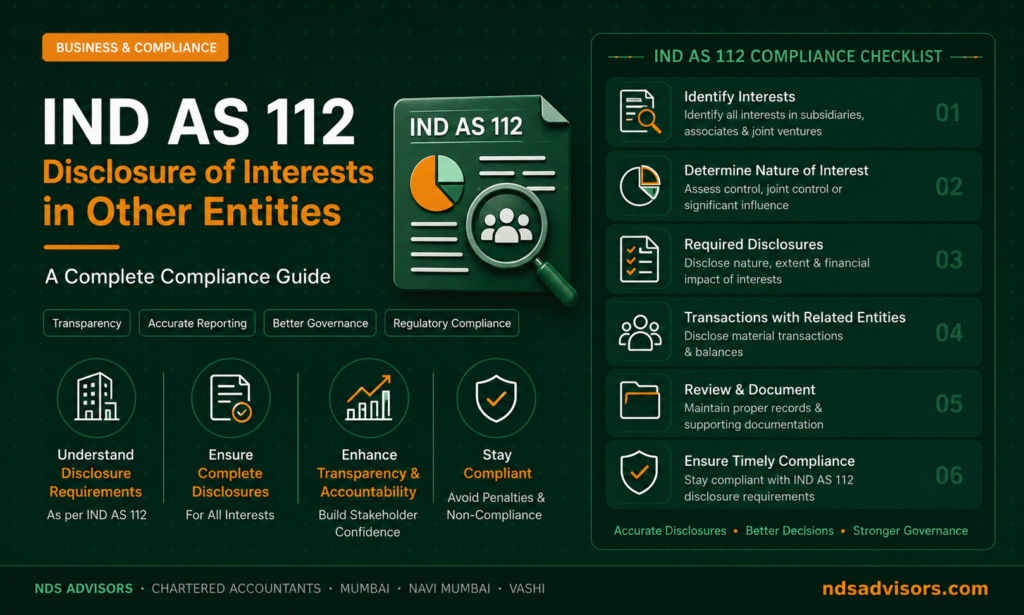
Ind AS 112 (Disclosure of Interests in Other Entities) is the standard that tells investors, analysts, lenders, and regulators what a company's consolidated financial statements do not immediately show: which entities are in the group and why, what restrictions exist on moving assets between group members, how significant the non-controlling interests are in each material subsidiary, what the company's exposure is to off-balance-sheet structured entities, and what significant judgments management has made in deciding who to consolidate and who to leave out.
For listed Indian companies, Ind AS 112 compliance intersects directly with SEBI LODR obligations — the definition of subsidiaries, material subsidiaries, and associates that drives quarterly disclosure obligations, related party transaction reporting, and audit committee review responsibilities flows directly from the Ind AS 110, 111, and 28 framework that Ind AS 112 requires to be disclosed. Getting Ind AS 112 disclosure wrong is therefore not just an accounting standards compliance gap — it can create gaps in regulatory disclosures to stock exchanges.
What Is Ind AS 112 and Why Does It Matter?
Before the introduction of Ind AS 112 (the Indian equivalent of IFRS 12), disclosure requirements for a company's interests in other entities were scattered across multiple standards — separate requirements existed for subsidiaries, associates, joint ventures, and off-balance-sheet vehicles, often with inconsistent levels of detail. The result was that a sophisticated investor or lender could read a set of consolidated financial statements without getting a clear picture of the full network of entities the reporting company was involved with, or the risks and restrictions attached to those relationships.
For companies that are in the process of or have recently completed Ind AS implementation, the notes required under Ind AS 112 often represent the largest increase in disclosure volume compared to previous Indian GAAP financial statements — particularly for groups with complex ownership structures, offshore entities, or structured financing arrangements.
The Five Entity Types Covered Under Ind AS 112
Ind AS 112 covers disclosures for five distinct types of interests. A common mistake is to provide a single combined disclosure for all interests without the entity-type-specific details that the standard requires.
| Entity Type | Relationship Basis | Accounting Method | Key Ind AS |
|---|---|---|---|
| Subsidiaries | Control — Ind AS 110 | Full consolidation | Ind AS 110 |
| Joint Operations | Joint control; rights to assets / obligations for liabilities | Line-by-line (own share) | Ind AS 111 |
| Joint Ventures | Joint control; rights to net assets | Equity method | Ind AS 111 + 28 |
| Associates | Significant influence (typically 20–50%) | Equity method | Ind AS 28 |
| Unconsolidated Structured Entities | Interest but not control | Off-balance-sheet disclosure | Ind AS 112 App. A |
The Judgment Disclosures — The Most Critical Requirement
The most distinctive — and most commonly deficient — aspect of Ind AS 112 is its requirement to disclose significant judgments and assumptions used in determining the nature of interests in other entities. These are not boilerplate disclosures — they must explain the specific reasoning applied in situations where the answer is not obvious from the numbers alone.
1Control Without Majority Voting Rights (De Facto Control)
Ind AS 110 defines control on a principles basis: an investor controls an investee when it has power over the investee, exposure to variable returns, and the ability to use its power to affect those returns. This means control can exist with less than 50 percent of the voting rights where, for example, the remaining shares are widely dispersed and in practice the company has always obtained the votes needed to pass resolutions.
Where a company consolidates an entity with less than a majority of the voting rights — on the basis of de facto control — Ind AS 112 requires explicit disclosure of the basis for that conclusion: the number of voting rights held, how they compare to the dispersion of remaining rights, and why in practice the company has power over the relevant activities.
2Significant Influence Assessments
The 20 percent ownership threshold for significant influence under Ind AS 28 is a rebuttable presumption — it can be overcome in either direction. A company may have significant influence with less than 20 percent if it has board representation, participates in policy decisions, or conducts material intercompany transactions. Equally, a company may hold 25 percent of voting rights but have no practical ability to influence the investee.
Ind AS 112 requires disclosure of the basis for the significant influence conclusion in either direction — where influence is asserted below the 20 percent threshold, or where the absence of influence is concluded above it. These disclosures are frequently missing or insufficiently specific in practice.
3Joint Operation vs Joint Venture Classification
The classification of a joint arrangement as a joint operation versus a joint venture depends on the rights and obligations of the parties — specifically whether they have direct rights to the assets and direct obligations for the liabilities. The legal form of the arrangement and its contractual terms must both be considered. Where a joint arrangement is conducted through a separate legal entity but is classified as a joint operation based on contractual terms that override the legal form, Ind AS 112 requires explicit disclosure of the facts and circumstances that led to that conclusion. This is one of the judgment disclosures most frequently challenged during statutory audit reviews.
4Investment Entity Determination
Under Ind AS 110, entities that meet the definition of an investment entity are exempt from consolidating their subsidiaries — they instead measure those subsidiaries at fair value through profit or loss. The investment entity conclusion requires all three criteria to be met: the entity obtains funds from investors to provide investment management services; its business purpose is to invest funds for capital appreciation, investment income, or both; and it measures and evaluates the performance of substantially all investments on a fair value basis.
Ind AS 112 requires any entity that concludes it is an investment entity to disclose that conclusion — and to disclose the facts and circumstances that support it, including where the entity does not exhibit all of the typical characteristics. Private equity firms, venture capital funds, and some family office holding structures may need to evaluate this determination carefully.
Disclosures for Subsidiaries — The Detail Level Required
Group Composition and Restrictions
Ind AS 112 requires the group composition to be disclosed — the names, countries of incorporation or residence, proportions of ownership interests, and (if different) proportions of voting rights held for significant subsidiaries. Where any of these details differ between the list of consolidated entities and the legal group structure, that difference and its basis must be disclosed explicitly.
Restrictions on cash flows within the group must also be disclosed: regulatory restrictions on dividends or intercompany transfers from foreign subsidiaries, lender covenants restricting asset transfers, minority shareholder agreement provisions requiring consent for distributions, or any other restrictions that limit the parent's ability to access the subsidiary's assets. For Indian groups with foreign subsidiaries subject to FEMA restrictions on repatriation, these disclosures are particularly relevant.
Non-Controlling Interests — The Subsidiary-Level Requirement
The standard requires, for each subsidiary with material NCI:
- The NCI's proportion of ownership interest and voting rights (separately, if different)
- Profit or loss allocated to the NCI for the period
- Accumulated NCI balance at the end of the period (not just the opening balance or the movement)
- Dividends paid to NCI holders during the period
- Summarised financial information for the subsidiary on a 100% basis before elimination adjustments: current and non-current assets, current and non-current liabilities, revenue, profit or loss, OCI, total comprehensive income, and cash flows
The requirement for subsidiary-level summarised financial information — not just the NCI's share — is frequently misunderstood. The standard requires the full picture of the subsidiary's financial position, allowing users to assess the scale and financial health of the subsidiary independently. For listed Indian groups with material minority stakes held by public shareholders — common in Indian conglomerates — these disclosures receive heightened scrutiny from SEBI, institutional investors, and proxy advisory firms.
Changes in Ownership Without Loss of Control
When a parent acquires additional shares from NCI or sells shares to NCI while retaining control, the transaction is treated as an equity transaction under Ind AS 110 — no gain or loss is recognised in P&L. Ind AS 112 requires disclosure of a schedule showing: the consideration paid or received, the change in the NCI's carrying amount, and the effect on the equity attributable to the parent. These disclosures are frequently omitted when groups undertake internal restructuring.
Disclosures for Joint Ventures and Associates
For joint ventures and associates accounted under the equity method, Ind AS 112 requires a consistent set of disclosures for each material joint venture or associate — plus aggregated information for immaterial ones. For each material joint venture or associate, the required disclosures include:
- Summarised financial information on a 100% basis: current and non-current assets and liabilities, revenue, profit or loss, OCI, total comprehensive income, depreciation, interest income, interest expense, and income tax expense
- A reconciliation of that summarised information to the carrying amount of the equity method investment in the consolidated balance sheet
- The fair value of the investment if a quoted market price is available (i.e., where the associate or JV is itself listed)
- The entity's share of any contingent liabilities incurred jointly with the joint venture or associate
- Significant restrictions on the ability of the JV or associate to transfer funds to the investor — dividend restrictions, regulatory limits, or lender covenants
- Unrecognised losses — where the group has stopped recognising its share of losses because they exceed the carrying amount of the investment
For Indian companies with significant joint ventures in infrastructure, power, or real estate — sectors where JV structures are common — the summarised financial information requirement means the finance team must collect audited or reviewed subsidiary financial data on a timeline compatible with the group reporting calendar. This is a data collection and IFRS implementation challenge that must be planned for in advance.
Disclosures for Unconsolidated Structured Entities
The structured entity disclosures are the area of Ind AS 112 that most frequently reveals off-balance-sheet risk to financial statement users — and where disclosure quality varies most significantly between companies. A structured entity under Ind AS 112 is an entity designed so that voting or similar rights are not the primary control mechanism.
Where a company has an interest in such an entity but does not consolidate it, Ind AS 112 requires:
Nature & Activities
The nature, purpose, size, and activities of the structured entity — described in enough detail that a reader can understand what it does and why it exists.
Maximum Exposure to Loss
A quantified worst-case figure covering all amounts at risk: the carrying amount of the investment plus off-balance-sheet commitments — guarantees, liquidity lines, contractual obligations to fund future losses.
Contractual Arrangements
Terms of any arrangements that could require financial support — liquidity facilities, credit enhancements, performance guarantees, and put options.
Financial Position & Income
Carrying amounts of assets and liabilities recognised in the consolidated balance sheet relating to the structured entity, plus income received during the period.
The maximum exposure to loss figure deserves particular attention. Understating maximum exposure is one of the most common structured entity disclosure deficiencies and is frequently identified in internal audit reviews of financial reporting processes.
Ind AS 112 and SEBI LODR: The Listed Company Dimension
For listed Indian companies, Ind AS 112 compliance has a direct regulatory dimension that goes beyond accounting standards compliance. SEBI's LODR Regulations impose a parallel set of obligations that depend on the same entity relationship determinations that Ind AS 112 requires to be disclosed:
- Material subsidiary policy: SEBI LODR requires listed companies to identify material subsidiaries (whose income or net worth exceeds 10% of the consolidated group) and comply with specific governance requirements — separate audit committee oversight, mandatory independent director appointments, and limitations on asset disposals or pledging. The Ind AS 112 group composition disclosure directly determines which entities fall within this scope.
- Related party transactions: SEBI LODR requires disclosure and approval of related party transactions, including transactions with subsidiaries, associates, and joint ventures. The Ind AS 112 disclosure of the complete group structure and ownership interests is the foundation for identifying which transactions are related party transactions requiring disclosure.
- Quarterly financial results: SEBI LODR requires listed companies to submit consolidated financial results each quarter. The entities included in those consolidated results must be consistent with the Ind AS 112-disclosed group composition.
- Annual report disclosures: The Companies Act and SEBI LODR both require statements of subsidiaries, associates, and JVs in the annual report — flowing from the same entity relationship determinations.
Common Ind AS 112 Compliance Gaps — What NDS Advisors Finds in Practice
Based on audit and assurance work and internal audit reviews across Indian groups of varying sizes and complexity, the following Ind AS 112 compliance gaps recur most frequently:
- Group composition list is incomplete — entities that are technically subsidiaries (because the parent has control through board majority or contractual arrangements) are omitted from the consolidation scope, typically because they are dormant or their financials are immaterial in aggregate.
- Judgment disclosures are templated and generic — the notes disclose that "significant judgments have been made in determining control" without explaining what those judgments were for specific entities, failing the Ind AS 112 requirement for entity-specific disclosure.
- NCI information is provided only at aggregate consolidated level — the disclosure shows total NCI across all subsidiaries rather than the subsidiary-level detail required for each subsidiary with material NCI.
- Summarised financial information for JVs and associates is missing or aggregated — where the group has multiple JVs, all are aggregated without identifying which are individually material and providing entity-specific summarised financials for those that are.
- Structured entity disclosures omit maximum exposure — the disclosure describes the nature of the structured entity relationship qualitatively without quantifying the maximum exposure to loss, which is a specific numeric requirement.
- Changes in ownership interest during the year are not disclosed — where the group acquired shares from NCI or sold shares during the year, the required equity schedule showing the financial effect is absent.
- Restrictions on fund transfers are understated — lender covenants restricting dividend payments from subsidiaries, or regulatory restrictions on intercompany transfers from foreign entities, are not specifically identified.
Frequently Asked Questions
What is Ind AS 112 and which companies must comply?
What are the most important judgment disclosures required under Ind AS 112?
What does Ind AS 112 require for non-controlling interests (NCI)?
What is a structured entity under Ind AS 112?
How does Ind AS 112 affect SEBI LODR compliance for listed companies?
What are the disclosure requirements for joint ventures under Ind AS 112?
CA Nainit Savla
Founder, NDS Advisors · Pune & Mumbai
Specialist in Ind AS / IFRS implementation, audit & assurance, and international tax advisory.