
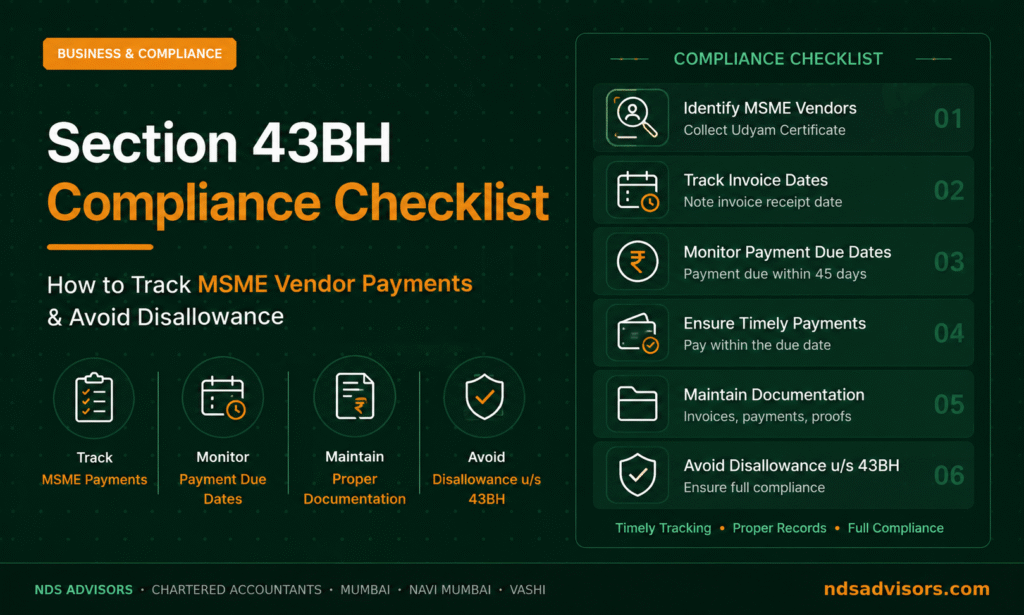
When Finance Act 2023 introduced Section 43B(h) into the Income Tax Act, it created a new compliance obligation for every Indian business that purchases goods or services from Micro or Small Enterprises: pay within the time limits prescribed under the MSMED Act or lose the tax deduction for that year. Three financial years on, Section 43B(h) non-compliance remains one of the most common — and most avoidable — tax disallowances found during NDS Advisors' tax audit and advisory engagements across Mumbai and Pune.
The reason is straightforward: many businesses have not built a systematic process to identify which vendors hold Udyam Registration as Micro or Small Enterprises, track payment due dates for each MSME invoice, and flag outstanding balances before the March 31 year-end. Without that system, the disallowance under Section 43B(h) is invisible until the tax audit — at which point it increases taxable income, creates additional tax liability, and requires disclosure in the Form 3CD report.
What Is Section 43B(h) and How Does It Work?
Section 43B of the Income Tax Act lists categories of expenditure that are deductible only when actually paid, not when accrued. The Finance Act 2023 added clause (h) to this section, effective from FY 2023-24 (AY 2024-25 onwards).
The critical word is "accrual basis" — Section 43B(h) overrides the normal accounting practice of recognising expenses when incurred. Even if your books show the expense and payable in full compliance with accounting standards, if the actual cash payment to the MSME vendor did not happen within the prescribed window, the disallowance applies for income tax purposes.
Which Vendors Are Covered? The Micro and Small Distinction
This is the most important initial determination. The provision applies only to Micro and Small Enterprises as classified under the MSMED Act 2006. It does not apply to Medium Enterprises or to unregistered vendors.
| Enterprise Category | Investment in Plant & Machinery | Annual Turnover | Sec 43B(h) Applies? |
|---|---|---|---|
| Micro Enterprise | ≤ Rs. 1 crore | ≤ Rs. 5 crore | YES ✓ |
| Small Enterprise | ≤ Rs. 10 crore | ≤ Rs. 50 crore | YES ✓ |
| Medium Enterprise | ≤ Rs. 50 crore | ≤ Rs. 250 crore | NO ✗ |
| Unregistered vendor (no UDYAM) | Not applicable | Not applicable | NO ✗ |
The MSME classification is based on the vendor's own Udyam Registration certificate. A buyer cannot independently determine a vendor's MSME classification — it must be verified from the UDYAM certificate issued by the Ministry of MSME. This creates a practical compliance step: collect the UDYAM certificate from every vendor before recording them in the accounting system, and note whether they are Micro, Small, or Medium.
Payment Timelines Under Section 43B(h)
Section 43B(h) references the payment timelines set out in Section 15 of the MSMED Act 2006.
| Situation | Payment Deadline | Key Rule |
|---|---|---|
| Written agreement exists between buyer and MSME supplier | 45 days from date of acceptance of goods/services | Contract cannot extend beyond 45 days — any clause giving longer credit is invalid |
| No written agreement (or agreement silent on payment terms) | 15 days from date of acceptance of goods/services | 15 days is the “appointed day” under MSMED Act — no exceptions |
What Counts as “Acceptance”?
- Physical receipt and actual acceptance of goods or completion of services → date of acceptance
- Delivery made, no objection raised within 15 days → date of delivery = deemed date of acceptance
- For services: date the service was completed and accepted by the buyer
- For partial deliveries: date of acceptance of each delivery consignment separately
How Section 43B(h) Disallowance Is Computed: A Worked Example
Company ABC (Mumbai-based trader) has MSME vendor XYZ registered as a Small Enterprise under UDYAM. ABC purchases goods from XYZ with a written payment agreement of 30 days from acceptance.
| Invoice | Date of Acceptance | Due Date (30 days) | Amount (Rs.) | Paid by 31 Mar? |
|---|---|---|---|---|
| Invoice 1 | 1 Feb 2027 | 3 Mar 2027 | 5,00,000 | Yes — paid 28 Feb |
| Invoice 2 | 10 Feb 2027 | 12 Mar 2027 | 3,00,000 | No — outstanding 31 Mar |
| Invoice 3 | 1 Mar 2027 | 31 Mar 2027 | 2,00,000 | Yes — paid 31 Mar |
| Invoice 4 | 15 Mar 2027 | 14 Apr 2027 | 4,00,000 | Not yet due at 31 Mar |
Section 43B(h) disallowance for FY 2026-27 = Rs. 3,00,000 (Invoice 2 only)
Invoice 1 and Invoice 3 paid within due date → Allowed. Invoice 4 not yet due at March 31 → Allowed in this year.
Invoice 2's Rs. 3,00,000 is added back to taxable income for FY 2026-27. At 25% tax rate → additional tax liability of Rs. 75,000. When Invoice 2 is paid in FY 2027-28, Rs. 3,00,000 becomes deductible in that year. The disallowance is permanent if never paid.
Year-End March 31 Checklist for Section 43B(h)
The most important Section 43B(h) compliance action happens at the financial year end. Run this checklist before closing the books for FY 2026-27:
- 1. Run vendor ledger report — export all outstanding payables at March 31, 2027
- 2. Filter for MSME vendors — identify Micro and Small Enterprise vendors in the payables list
- 3. Verify UDYAM status — confirm current UDYAM certificates are on file for all flagged vendors
- 4. Identify acceptance dates — for each outstanding invoice, confirm the goods/services acceptance date
- 5. Calculate due dates — compute 15-day (no agreement) or 45-day (with agreement) deadlines from acceptance date
- 6. Flag overdue amounts — identify invoices where the due date has passed at March 31
- 7. Process urgent payments — where possible, pay overdue MSME invoices before March 31 (before books close)
- 8. Compute remaining disallowance — total of all outstanding MSME amounts where due date has passed and payment not made
- 9. Add back in tax computation — include the disallowance amount in the income tax computation for FY 2026-27
- 10. Disclose in Form 3CD — report the Section 43B(h) disallowance in Clause 26 of the tax audit report (if applicable)
Ongoing Section 43B(h) Compliance — Throughout the Year
Year-end checks are a safety net. The real compliance happens throughout the year. For FY 2026-27, establish these ongoing processes:
MSME Vendor Identification and Onboarding
For every new vendor, collect the UDYAM Registration Certificate before the first purchase order is raised. The certificate shows the UDYAM Registration Number, enterprise name and address, type — Micro, Small, or Medium, and date of registration. Tag each vendor in your ERP or accounting system as Micro, Small, Medium, or Non-MSME. Set the Section 43B(h) flag to "applicable" for Micro and Small vendors only.
Annual UDYAM Certificate Refresh
MSME classifications change as businesses grow. A vendor who was a Micro Enterprise in FY 2024-25 may have moved to Small — or may have crossed into Medium (which would make Section 43B(h) inapplicable). Collect updated UDYAM certificates from all MSME vendors annually — ideally at the start of each financial year — and update tags in your accounting system.
Invoice Acceptance Date Tracking
When a delivery from an MSME vendor is received, record the acceptance date (not the invoice date) against the payable. Set an automated reminder for the payment due date (Day 15 or Day 45 from acceptance) for each MSME invoice. A colour-coded ageing report filtered for MSME vendors — showing invoices approaching and past their due dates — is an effective monitoring tool.
Prioritise MSME Vendor Payments in the Payment Cycle
Many businesses process vendor payments on a weekly or fortnightly cycle. Build a priority flag for MSME vendor invoices approaching their Section 43B(h) deadline. A payment delayed by one week within the normal cycle might push an MSME invoice past the 45-day deadline — creating a disallowance that a simple prioritisation step would have prevented.
Monthly Ageing Review
At the end of each month, run a report of MSME vendor payables outstanding beyond the due date. Monthly monitoring catches issues early and allows corrective payment before the March 31 cut-off. This should be part of the standard monthly internal audit checklist for any business with significant MSME vendor spend.
Special Situations Under Section 43B(h)
Situation 1 — Vendor Claims MSME Status but Has No UDYAM Registration
Section 43B(h) applies to enterprises registered under the MSMED Act. A vendor who operates as a Micro or Small business but has not registered under UDYAM is technically not a "Micro or Small Enterprise" for Section 43B(h) purposes. Best practice: obtain a vendor declaration on MSME status; collect the UDYAM certificate if they claim MSME status; and update your compliance flag only when the certificate confirms Micro or Small classification.
Situation 2 — Goods Returned or Services Disputed
If goods are returned or services disputed, the acceptance is incomplete or invalidated. Section 43B(h) compliance does not apply to amounts genuinely disputed or under legal proceedings — the payment obligation under MSMED Act does not apply while a dispute is pending before an appropriate authority. However, the dispute must be genuine and formally raised.
Situation 3 — Partial Payments
If a partial payment is made to an MSME vendor, only the unpaid portion outstanding beyond the deadline is disallowed under Section 43B(h). Example: Rs. 5 lakh payable, Rs. 3 lakh paid before deadline → only Rs. 2 lakh is subject to disallowance if not paid by year-end.
Situation 4 — Advance Payments
Advance payments made to MSME vendors before goods or services are delivered and accepted are not subject to the Section 43B(h) timeline — no goods or services have been accepted, so no payment obligation under the MSMED Act has arisen yet.
Section 43B(h) and Tax Audit — Form 3CD Disclosure
For businesses subject to tax audit under the Income Tax Act — where turnover exceeds Rs. 1 crore for traders (Rs. 50 lakh for professionals) — the Section 43B(h) disallowance must be disclosed in Form 3CD. The auditor reports under Clause 26:
- The nature of expenditure — payments to Micro or Small Enterprises under the MSMED Act
- The aggregate amount outstanding beyond the prescribed time limit at year-end
- The amount disallowed under Section 43B(h) to be added to taxable income
Tax auditors at NDS Advisors specifically verify during audit: (a) whether UDYAM certificates are collected from all vendors claiming MSME status; (b) whether outstanding payables include amounts to Micro or Small enterprises beyond the 45/15 day limit; and (c) whether the disallowance is correctly computed and reflected in the tax computation before Form 3CD is certified.
Impact on Working Capital Management
Section 43B(h) creates a hard deadline for payment that did not previously exist under the income tax framework. The tax cost of delayed payment is real: for a Rs. 50 lakh MSME payable outstanding beyond the deadline at March 31, the additional tax liability at 25% rate is Rs. 12.5 lakh in the current year (recovered next year when paid). That Rs. 12.5 lakh is essentially a cost of capital on the delayed payment.
Early Payment Discounts
Negotiate early payment discounts with MSME vendors — pay within 20–30 days instead of 45, and capture a discount that partly offsets the working capital impact.
Segregated Payment Batches
Run a separate payment batch specifically for MSME vendors approaching their Section 43B(h) deadline, before the normal payment cycle runs.
Advance Payments
For large or recurring MSME vendor contracts, structure advance payments against milestone deliveries to manage the payables timeline within the Section 43B(h) window.
Frequently Asked Questions
What is Section 43B(h) of the Income Tax Act?
Does Section 43B(h) apply to payments to Medium Enterprises?
What is the payment timeline under Section 43B(h)?
How is Section 43B(h) disallowance computed at year-end?
Does Section 43B(h) need to be disclosed in the tax audit report?
What if a vendor is an MSME but does not have a UDYAM registration?
CA Nainit Savla
Founder, NDS Advisors · Mumbai & Pune
Specialist in income tax advisory, MSME compliance, tax audits, and outsourced accounting for Indian businesses.