
An importer in Navi Mumbai buys a machine from Germany in October and pays for it in March. The rupee weakens in between. The accountant books an exchange loss, the auditor signs it, and everyone assumes the matter is closed. Then the tax computation is prepared, the loss is added back, and the owner wants to know why a real cost that left the bank account is not deductible.
It is a fair question with an unsatisfying answer: because the accounting standard and the tax law are asking different things. Ind AS 21 asks how the transaction should be reported to shareholders. The tax provisions ask what should be taxed and when. Where those purposes diverge, so do the numbers — and the business is left maintaining two versions of the same fact. This article sets out where that happens and what has to be tracked.
- Two rulebooks govern the same transaction. Ind AS 21 decides what goes in your books; ICDS VI and the specific provisions of the income tax law decide what goes in your tax computation. They do not always agree.
- The largest divergence involves imported capital assets. Where an asset is acquired from outside India, exchange differences arising on payment are adjusted to the cost of that asset for tax purposes, on a payment basis — while Ind AS 21 sends the same difference to profit and loss.
- That single rule creates a permanent split between your book fixed asset register and your tax block of assets, and it persists for the whole life of the asset.
- Translating an overseas branch produces another divergence. Ind AS 21 parks the difference in a reserve within equity; for tax the branch is treated as though its transactions were your own, so the difference reaches income.
- Forward contracts diverge too. Premium or discount at inception is amortised over the life of the contract for tax, while your books may carry the instrument at fair value.
- None of this is optional. If you report under Ind AS and have foreign currency exposure, a separate exchange difference working is not good practice — it is the only way the return can be filed correctly.
Two Rulebooks, One Transaction
It helps to be clear about what governs what.
- Ind AS 21 governs your financial statements. It determines how transactions in a foreign currency are recorded, how monetary items are restated at the reporting date, and where the resulting differences are presented.
- ICDS VI governs the computation of taxable income. The Income Computation and Disclosure Standards were notified for computing income under business or profession and other sources for taxpayers on the mercantile system. They do not affect your books at all — they exist only for the return.
- Specific statutory provisions override both. Where the law makes express provision for exchange differences on assets acquired from outside India, that provision prevails over the general standard.
- The result is a reconciliation, not a choice. You do not elect one treatment. You apply Ind AS in the books, apply the tax rules in the computation, and carry the difference as a reconciling item.
Where the Two Treatments Part Company
| Situation | In your books under Ind AS 21 | In the tax computation |
|---|---|---|
| Trade receivable or payable in foreign currency, restated at year end | Exchange difference to profit or loss | Broadly the same treatment — recognised as income or expense |
| Settlement of a foreign currency trade payable | Difference to profit or loss | Broadly the same — no adjustment usually needed |
| Asset acquired from outside India, paid for later | Exchange difference on the liability goes to profit or loss | Adjusted to the actual cost of the asset when payment is made, not deducted |
| Foreign currency loan taken specifically to acquire that imported asset | Exchange difference to profit or loss | Adjusted to the cost of the asset on repayment |
| Foreign currency liability for an asset purchased within India | To profit or loss | Follows the general standard rather than the imported-asset rule |
| Non-monetary items carried at historical cost | Not retranslated | Not retranslated — differences neither taxable nor deductible |
| Translating an overseas branch or foreign operation | Difference to other comprehensive income, held in a translation reserve | Treated as though the branch transactions were your own, so it reaches income |
| Forward contract taken to hedge an existing exposure | Measured under the financial instruments standard, often at fair value | Premium or discount at inception amortised over the life of the contract |
| Forward contract for trading or speculation | Fair value movements recognised | Treated separately from the ordinary rule; recognition follows the specific provision |
| Cancellation or renewal of a forward contract | Recognised when it occurs | Profit or loss recognised in the year of cancellation or renewal |
Simplified for orientation. The precise position depends on the terms of each instrument and on the assessee’s circumstances. Read the notified text before applying any row.
The Imported Asset Rule, and Why It Surprises People
This is the divergence that produces the most argument in practice, so it is worth working through with numbers.
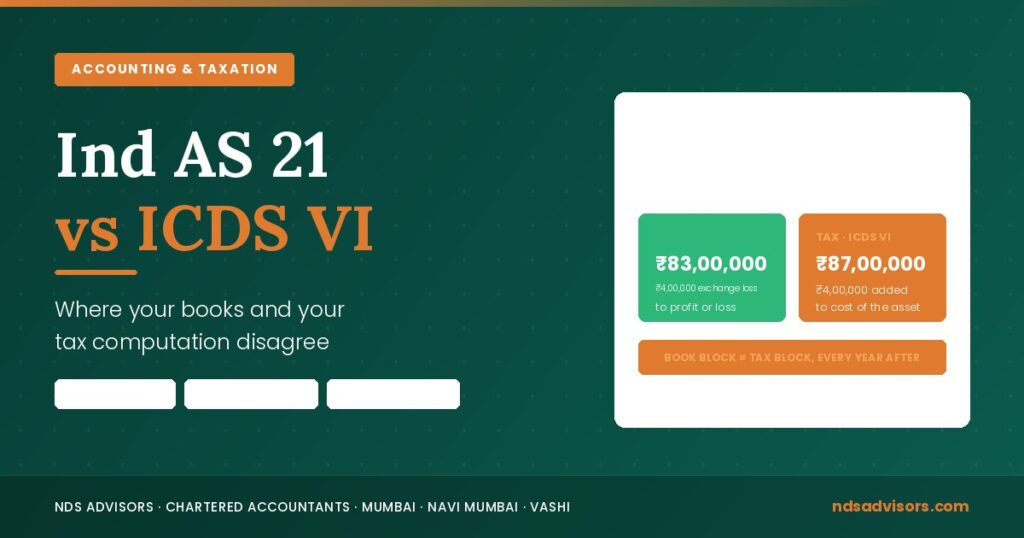
Take a machine imported for USD 1,00,000. On the date of acquisition in October the rate is ₹83, so the asset comes into the books at ₹83,00,000. Payment is made the following March when the rate has moved to ₹87, costing ₹87,00,000.
In your books — Ind AS 21
That ₹4,00,000 is an exchange loss in profit or loss. The asset stays in the books at ₹83,00,000 and is depreciated on that figure.
In the tax computation — the imported-asset rule
For tax it goes the other way. Because the asset was acquired from outside India, the ₹4,00,000 is added to the actual cost of the asset in the year of payment. It is not deductible as an expense. The asset enters the tax block at ₹87,00,000.
- The adjustment happens on payment, not on accrual, and applies regardless of the method of accounting followed.
- It applies to the repayment of foreign currency borrowings taken specifically to acquire that asset, as well as to the payment for the asset itself.
- It applies only to assets acquired from outside India. A foreign currency liability for an asset bought within India falls under the general standard instead.
- Where a block of assets is involved, the adjustment flows to the written down value of the block whether or not the amount was capitalised in the books.
What the Reconciliation Looks Like in Practice
Pulling the divergences together for a single importer with an overseas branch and a hedging programme, the year-end adjustment to arrive at taxable income might look like this.
Illustrative figures for a hypothetical importer, shown to demonstrate the shape of the working rather than to represent any actual business. The trade payables line is nil because the book and tax treatments agree there — which is exactly why it belongs in the schedule, so a reviewer can see it was considered.
Three of those four lines require an adjustment and one does not. The discipline is to list every category of exchange difference, including the ones that agree, so that the working is complete and can be re-performed next year by someone else.
The Overseas Branch: A Reserve in the Books, Income for Tax
If your business runs a branch, project office or other foreign operation whose functional currency differs from the rupee, this divergence applies every single year rather than only when a transaction settles.
- Under Ind AS 21 the results and position of that operation are translated and the resulting difference is recognised in other comprehensive income, accumulating in a translation reserve within equity. It never touches reported profit while the operation is held.
- For tax purposes the financial statements of the foreign operation are translated as if its transactions had been those of the assessee directly — so the differences fall into the ordinary computation rather than into a reserve.
- The consequence is an annual reconciling item that has no counterpart in your profit and loss account, which makes it easy to overlook entirely.
- It is also the item most likely to be queried, because a reviewer comparing the return against the financial statements will not find it in the profit figure.
Forward Contracts: Two Different Clocks
Hedging is where the timing difference becomes most visible, because the two frameworks recognise the same economic outcome over different periods.
- For tax, any premium or discount arising at the inception of a forward exchange contract is amortised as income or expense over the life of the contract.
- Exchange differences on such a contract are recognised as income or expense in the year in which the rates change.
- Any profit or loss on cancellation or renewal of the contract is recognised in the year the cancellation or renewal occurs.
- Contracts entered into for trading or speculation, and those covering a firm commitment or a highly probable forecast transaction, are dealt with separately from that general rule.
- Your books, meanwhile, apply the financial instruments standard — which for many entities means fair value movements recognised as they arise, and hedge accounting only where the documentation requirements have been met.
The practical outcome is that a hedge which nets to the same result over its life will land in different years in the two sets of numbers. That is a timing difference rather than a permanent one, but it still has to be tracked and reversed.
The Working Paper to Build
If you take one thing from this article, make it this schedule. It should be prepared alongside the accounts, not reconstructed at return-filing time.
| Column | What goes in it | Why it matters |
|---|---|---|
| Nature of the item | Trade receivable, trade payable, imported capital asset, foreign loan, branch translation, forward contract | Determines which rule applies before any number is entered |
| Origin of the asset, where relevant | Acquired from outside India, or within India | Decides whether the imported-asset rule applies at all |
| Amount in books | Exchange difference recognised in profit or loss or in other comprehensive income | The starting point for the reconciliation |
| Tax treatment | Allowed, disallowed, or capitalised to the asset | The adjustment itself |
| Timing basis | Accrual for the books; payment basis where the imported-asset rule applies | Explains why the two years differ |
| Adjustment to income | Addition or deduction in the computation | What actually reaches the return |
| Effect on tax depreciation | Change to the written down value of the block | Carries forward into every subsequent year |
| Supporting evidence | Import documents, bank advice, contract notes, rate source | The first thing requested if the matter is examined |
A schedule in this form takes a morning to set up and saves considerably more than that at assessment.
One Thing to Check Under the New Income Tax Statute
The income tax law was replaced with effect from 1 April 2026. The substance described above — exchange differences on revenue items reaching income, differences on imported capital assets adjusting the cost of the asset, and separate treatment of forward contracts — reflects a settled policy that the new statute carries forward.
What has changed is the numbering. Provisions familiar by their old section numbers now sit elsewhere, and the notified computation standards are read against the new framework. Two practical consequences:
- Working papers, engagement letters and internal checklists that cite the old section numbers should be updated for periods governed by the new Act, even though the treatment itself is unchanged.
- Where an assessment covers an earlier year, the old references remain the correct ones for that year. Do not retrofit new numbering onto historical computations.
Six Errors We See Repeatedly
- Deducting the exchange loss on an imported machine. The most common one, and the one most likely to be picked up. It belongs in the cost of the asset, not the profit and loss account, for tax.
- Adjusting on accrual rather than on payment. For imported assets the adjustment is triggered by payment. Restating the liability at year end does not create the tax adjustment.
- Ignoring the branch translation reserve. It sits in equity, never appears in the profit figure, and is therefore invisible to anyone reconciling from the profit and loss account alone.
- Running one fixed asset register. Once the imported-asset rule bites, the book block and the tax block have permanently different values. One register cannot serve both.
- Treating all forward contracts alike. Hedging an existing exposure, covering a forecast transaction and trading are three different situations with three treatments.
- Leaving the reconciliation to the return. By then the rates, the payment dates and the contract terms have to be reconstructed. Prepare it with the accounts, while the evidence is at hand.
How We Help Importers and Exporters With This
Businesses around Navi Mumbai and Vashi tend to have exactly the exposure this article describes — imported plant, foreign currency payables, and sometimes an overseas office. We build the exchange difference schedule as part of the year-end file rather than as a separate exercise at filing time.
- Where the books are the issue, the treatment is settled during Ind AS implementation and reviewed again at audit.
- Where the computation is the issue, the reconciliation and the separate depreciation schedule are prepared as part of business tax filing.
- Cross-border payments bring their own trail — our Form 15CA and 15CB and international tax teams handle that alongside.
- For businesses setting up import or export operations, the reporting consequence is worth mapping before the first consignment — which sits with our import export code and advisory work.
Frequently Asked Questions
Is the exchange loss on imported machinery deductible?
Does ICDS override Ind AS?
We have an overseas branch. Why is there a tax adjustment when nothing hit our profit?
Do I need a separate fixed asset register for tax?
What about exchange differences on ordinary trade receivables and payables?
The bottom line
Foreign exchange is one of the few areas where doing the accounting correctly still leaves the tax position wrong. Ind AS 21 tells you what to report; the tax provisions tell you what to compute, and on imported assets, overseas branches and forward contracts they reach different answers on purpose. Build the reconciliation schedule alongside the accounts, keep a separate tax depreciation record from the year of import, and the annual argument about why a real cost is not deductible stops happening.
Suit No. 102, L1, Ashok Premises, Nicholas Road, Andheri (East), Mumbai 400069 · Serving Navi Mumbai & Vashi
From the taxation desk at NDS Advisors, Chartered Accountants
Mumbai · Navi Mumbai · Vashi
Much of our work sits with importers, exporters and manufacturers around Mumbai, Navi Mumbai and Vashi, where the accounts and the computation regularly pull in different directions. Numbers in this article have been kept deliberately simple so the mechanics are visible. Accounting standards and the income tax statute both move — check what governs your financial year and your assessment year before you act on any of it.