
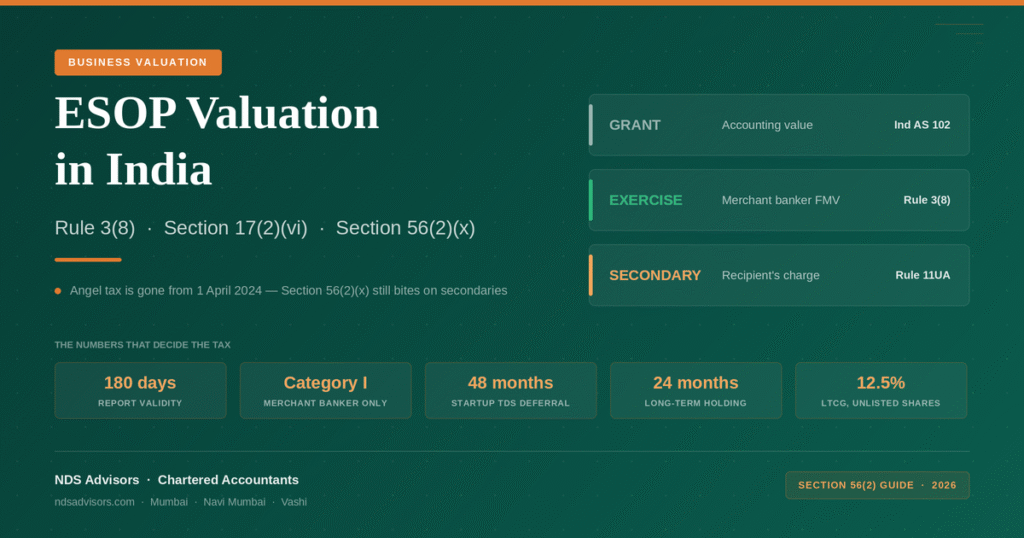
ESOP valuation in India is the process of determining the fair market value of a company's shares so that employee stock options can be granted, exercised and taxed correctly under the Income-tax Act, 1961 and the Companies Act, 2013. For an unlisted company, that value must be certified by a merchant banker registered with SEBI under Rule 3(8) of the Income-tax Rules, 1962 before an employee exercises an option, because the perquisite tax the employee pays is computed on that certified figure.
A wrong number carries real consequences: the company under-deducts tax at source under Section 192, the employee receives a demand two years later, and the scheme becomes a diligence problem in the next funding round. For founders who use equity to hire senior talent without burning cash, the ESOP valuation report is not paperwork. It decides how much tax lands on your team, and when.
- Only a Category I merchant banker will do. For unlisted shares, Rule 3(8) names the SEBI-registered merchant banker specifically — a registered valuer under Section 247 performs a different statutory function.
- The report expires in 180 days. Fair market value may be certified as on the exercise date or any earlier date within 180 days of it, and no further.
- Rule 3(8) and Rule 11UA are not interchangeable. One drives the Section 17(2)(vi) perquisite, the other drives Section 56(2)(x) on transfers.
- Angel tax is gone; Section 56(2)(x) is not. Section 56(2)(viib) was abolished for shares issued on or after 1 April 2024, but secondary transfers below fair value remain chargeable on the recipient.
- The startup deferral is timing, not relief. Section 192(1C) pushes the TDS out by up to forty-eight months for DPIIT recognised startups holding a Section 80-IAC certificate.
What Is ESOP Valuation in India and Why Is It Legally Required?
ESOP valuation in India is an independent determination of the fair market value of unlisted shares, used at two separate moments in the life of a stock option. It is legally required because Section 17(2)(vi) of the Income-tax Act, 1961 defines the taxable perquisite as the fair market value of the shares on the date of exercise, reduced by the amount the employee actually pays. Without a valuation, that figure cannot be computed at all.
An employee stock option is a right, not an obligation, to buy a fixed number of shares at an ESOP exercise price locked in on the grant date. Two different valuations attach to it.
Valuation one — accounting, at grant
Drives the share-based payment expense recorded under Ind AS 102 or, outside the Ind AS framework, the ICAI Guidance Note on Accounting for Employee Share-based Payments. This number shapes what your profit and loss statement looks like to an investor.
Valuation two — tax, at exercise
Drives the Section 17(2)(vi) perquisite. This number decides what your employee owes the tax department. Boards routinely conflate the two, then discover during due diligence that neither is defensible.
Our business valuation services team handles both.
Which Laws Govern ESOP Valuation in India?
Four instruments govern ESOP valuation in India: the Companies Act, 2013 for issuance, the Income-tax Act, 1961 for taxation, the Income-tax Rules, 1962 for the valuation mechanics, and the SEBI (Share Based Employee Benefits and Sweat Equity) Regulations, 2021 for listed companies. Unlisted companies deal with the first three.
| Provision | What it governs |
|---|---|
| Section 62(1)(b), Companies Act, 2013 with Rule 12, Companies (Share Capital and Debentures) Rules, 2014 | How an ESOP scheme under the Companies Act, 2013 is approved, who counts as an eligible employee, and the minimum one-year gap between grant and vesting |
| Section 17(2)(vi), Income-tax Act, 1961 | Brings the exercise-date gain into the employee's salary income as a perquisite |
| Rule 3(8), Income-tax Rules, 1962 | Prescribes how the fair market value of unlisted shares is arrived at, and by whom |
| Section 56(2)(x) with Rule 11UA | Applies where shares move between parties for inadequate consideration, typically in secondary sales rather than at allotment |
| Sections 192 and 192(1C) | Tax deduction at source and the deferral available to eligible startups |
Who Can Issue an ESOP Valuation Report in India?
For an unlisted company, only a merchant banker registered with SEBI as a Category I merchant banker can issue the ESOP valuation report used to compute the perquisite under Rule 3(8) of the Income-tax Rules. A registered valuer appointed under Section 247 of the Companies Act, 2013 performs a different statutory function and cannot substitute for the merchant banker valuation on the tax side.
This is the single most common error we correct. A founder obtains a chartered accountant's certificate, or a registered valuer report prepared for a preferential allotment, and uses it to compute the perquisite at exercise. The valuation may be entirely sound as a matter of finance and still be the wrong instrument. Rule 3(8) names the merchant banker specifically, and an assessing officer reviewing a Section 192 deduction looks for exactly that.
| Particulars | Category I merchant banker | Registered valuer |
|---|---|---|
| Governing provision | Rule 3(8), Income-tax Rules, 1962 | Section 247, Companies Act, 2013 |
| Use for ESOP perquisite | Mandatory for unlisted shares | Cannot substitute |
| Typical other use | Tax valuations of unlisted shares | Preferential allotment under Section 62(1)(c), share swaps, Companies Act valuations |
| Small-company relief | None — no threshold, and a DPIIT recognised startup is not excused | Not applicable |
Many companies need both professionals in the same financial year, for different transactions. Listed companies avoid the question entirely: Rule 3(8) fixes fair market value as the average of the opening and closing price on the exercise date, on the recognised stock exchange recording the highest trading volume that day.
How Is the Fair Market Value of Unlisted Shares Calculated for ESOPs?
The merchant banker determines the fair market value of unlisted shares on the specified date using an established approach — most commonly discounted cash flow, net asset value, or a market approach based on comparable companies and recent transactions. Rule 3(8) does not mandate a particular method, which places the burden of justifying the choice on the valuer and the board.
In practice the approach follows the stage of the business:
- Early-stage with a recent priced round: usually valued off that round, adjusted for the rights attached to preference shares.
- Capital-intensive business: better served by net asset value.
- Profitable and predictable: supports an earnings multiple drawn from listed comparables, discounted for size and illiquidity.
- Discounted cash flow: works where management can defend a forecast, which is a higher bar than most founders expect.
Two adjustments then dominate: a discount for lack of marketability, reflecting that an employee in an unlisted company cannot sell freely, and a minority discount where the option holder acquires no influence. Both must be reasoned in the report, not asserted.
A Rule 11UA valuation is a different exercise producing a different number. For unquoted equity shares, Rule 11UA prescribes a book-value based formula that adjusts assets and liabilities and divides by paid-up equity. That figure governs Section 56(2)(x), not the perquisite. Companies that use the Rule 11UA valuation to set an ESOP exercise price, or the Rule 3(8) figure for a share transfer, have applied the right arithmetic to the wrong provision.
How Does Section 56(2) Apply to ESOPs After the Angel Tax Abolition?
Section 56(2)(x) continues to apply to ESOP shares that change hands below fair market value in a secondary transaction. Section 56(2)(viib), the provision known as angel tax, was abolished by the Finance (No. 2) Act, 2024 and does not apply to shares issued on or after 1 April 2024, that is, from assessment year 2025-26 onwards.
The two provisions were always aimed at different targets and are still widely confused. Section 56(2)(viib) taxed the company on the premium it received when issuing shares above fair market value, which is why it dominated fundraising conversations and drove the entire angel tax exemption regime for recognised startups. Section 56(2)(x) taxes the recipient on property received for no consideration or inadequate consideration, where the shortfall exceeds fifty thousand rupees.
For ESOPs, the allotment itself sits under Section 17(2)(vi) as employment income, so Section 56(2)(x) is not the operative charge at exercise. It becomes live afterwards. An employee selling shares to an incoming investor at a negotiated discount, a founder buying back vested shares from a departing colleague, or a transfer into a family trust are all transactions where the recipient's Rule 11UA valuation determines whether a charge arises. Structuring these is corporate financial advisory work, not an afterthought at the point of signature.
How Do You Complete an ESOP Valuation in India Step by Step?
A defensible ESOP valuation in India follows eight steps, from confirming the scheme is validly constituted through to disclosing the grant in the Board's Report. Skipping any of them tends to surface later, usually during investor diligence.
- Confirm the scheme is validly constituted. Check that the ESOP scheme under the Companies Act, 2013 was approved under Section 62(1)(b), that the explanatory statement carried the disclosures Rule 12 requires, and that every grantee is an eligible employee. Independent directors and, ordinarily, promoters and directors holding more than ten per cent of equity are excluded. A DPIIT recognised startup is exempt from that exclusion for ten years from incorporation.
- Fix the trigger and the specified date. Identify whether you are valuing for grant-stage accounting or exercise-stage tax, and pick the specified date accordingly. For the perquisite, that is the exercise date or any date within the preceding 180 days. Record the choice in the board minutes so it is not reconstructed after the fact.
- Appoint a SEBI-registered Category I merchant banker. Engage the banker in writing, with the scope, specified date and purpose stated explicitly. A merchant banker valuation for ESOP purposes should say on its face that it is issued for Rule 3(8), which removes any later argument about what the report was for.
- Assemble the valuation information pack. Provide three years of audited financial statements, the fully diluted capitalisation table including the unissued option pool, the current shareholders' agreement and term sheet, board-approved projections, the debt schedule and related-party details. Incomplete packs are the main reason valuations slip past exercise windows.
- Agree the approach and the discounts. Settle the primary method and the basis for any marketability or minority discount before the draft is written. Confirm the share count is fully diluted, including unvested and ungranted pool shares, because valuing on an issued-shares basis inflates per-share value and overstates every employee's perquisite.
- Place the report before the board. Pass a resolution recording the certified fair market value, the ESOP exercise price and the date of the report. That resolution connects the valuation to the grant or exercise in your statutory records, and it is the first document a diligence team asks to see.
- Compute the perquisite and deposit the tax. The perquisite equals certified fair market value less exercise price, multiplied by shares exercised. Deduct tax under Section 192 at the employee's slab rate, deposit it on time, and report it in Form 12BA and Form 16. Where the company qualifies, decide now whether to apply the Section 192(1C) deferral.
- Record, disclose and account for the grant. Update the register of employee stock options in Form SH-6, make the Rule 12(9) disclosures in the Board's Report, and recognise the share-based payment expense under Ind AS 102 or the ICAI Guidance Note. Keep the ESOP valuation report with the statutory records, not in a founder's inbox.
What Are the Tax Implications of ESOPs for Employees and Startups?
ESOP taxation for startups and established companies alike runs in two stages: the Section 17(2)(vi) perquisite when the option is exercised, and capital gains when the shares are sold. Eligible startups can defer the first charge by up to forty-eight months, which is the single most useful concession in the regime.
Stage one — perquisite at exercise
The Section 17(2)(vi) perquisite equals the certified fair market value on the specified date, less the ESOP exercise price actually paid, multiplied by the shares exercised. This is salary income, taxed at the employee's slab rate, with tax deducted under Section 192. The cash strain is obvious: an employee at an unlisted company pays tax in cash on a gain they cannot yet monetise.
Stage two — capital gains on sale
When the shares are sold, the cost of acquisition is the fair market value already taxed as a perquisite, so the same gain is not taxed twice. The holding period runs from the date of allotment. For unlisted shares held more than twenty-four months, long-term capital gains are taxed at 12.5 per cent without indexation following the Finance (No. 2) Act, 2024; shorter holdings are taxed at slab rates. Listed shares sold on an exchange follow the securities transaction tax regime instead.
The startup deferral under Section 192(1C)
A DPIIT recognised startup holding a certificate of eligible business under Section 80-IAC may defer deduction of tax on the perquisite to the earliest of three events: forty-eight months from the end of the relevant assessment year, the date the employee sells the shares, or the date the employee leaves. The Section 192(1C) deferral is a timing benefit, not an exemption, and it reaches only that narrow class of companies. Whether yours qualifies for the Section 80-IAC tax exemption should be settled before you promise employees anything about deferred tax, not after.
How Has ESOP Regulation in India Evolved Since 1991?
Employee share ownership was effectively absent from Indian corporate practice before 1991 and acquired a full statutory framework only with the Companies Act, 2013. That arc explains why the current rules sit across so many separate provisions.
Before 1991: administered pricing, no equity culture
Under the Companies Act, 1956 and the Capital Issues (Control) Act, 1947, the Controller of Capital Issues fixed the price at which companies could issue shares. Share prices were an administrative outcome rather than a market one, and the Foreign Exchange Regulation Act, 1973 restricted cross-border shareholding tightly. In that setting there was no reason for a salaried employee to hold equity in an employer, and no mechanism to value it if they did.
1991 to 2013: liberalisation and the first Indian ESOPs
The Controller of Capital Issues was abolished in 1992 and the Securities and Exchange Board of India Act, 1992 introduced free pricing of issues. Infosys created an employee welfare trust in 1994, widely treated as the first significant Indian ESOP, and the information technology boom made equity a hiring currency. SEBI issued guidelines for listed-company schemes in 1999, and the Finance Act, 1999 brought ESOPs into the perquisite net. The Finance Act, 2007 briefly moved the charge to Fringe Benefit Tax at company level; the Finance (No. 2) Act, 2009 abolished FBT and restored perquisite taxation under Section 17(2)(vi).
2013 to today: a codified framework
The Companies Act, 2013 and Rule 12 of the Companies (Share Capital and Debentures) Rules, 2014 gave unlisted companies a statutory framework for the first time. Section 56(2)(x) replaced the earlier gift-tax provisions from 1 April 2017, and the SEBI (Share Based Employee Benefits and Sweat Equity) Regulations, 2021 consolidated the listed-company regime. The Finance Act, 2020 introduced the Section 192(1C) deferral that made ESOP taxation for startups commercially workable, and the Finance (No. 2) Act, 2024 removed Section 56(2)(viib) altogether. Companies incorporating today should register under Startup India early, because several of these benefits attach to DPIIT recognition rather than to the private limited company form itself.
Why Founders and CFOs Work with NDS Advisors on ESOPs
- Scheme structuring that survives diligence: Section 62(1)(b) approval, Rule 12 disclosures and eligible-employee testing checked before the first grant, not after the term sheet.
- Merchant banker coordination: engagement scoped to Rule 3(8) on its face, with the information pack assembled so the report lands inside the exercise window.
- Perquisite computation and Section 192 compliance: fully diluted share counts, Form 12BA and Form 16 reporting, and a considered call on the Section 192(1C) deferral.
- The right instrument for the right provision: Rule 3(8) for the perquisite, Rule 11UA for Section 56(2)(x) transfers, registered valuer where the Companies Act demands one.
- Records cleaned up before the round: Form SH-6 register, board resolutions and Board's Report disclosures reconstructed where they were never maintained.
What Do Founders Most Often Ask About ESOP Valuation in India?
What is ESOP valuation in India?
Who issues an ESOP valuation report in India?
How long is an ESOP valuation report valid in India?
Is a merchant banker valuation mandatory for ESOP exercise in an unlisted company?
Can I use the same valuation report for an ESOP and for a funding round?
How is Section 56(2) relevant to ESOPs after angel tax was abolished?
The bottom line
An ESOP is a promise about equity, but the tax is settled by a document. Get the instrument right — a Category I merchant banker report, scoped to Rule 3(8), dated inside 180 days of the exercise — and the perquisite computation, the Section 192 deduction and the diligence file all fall into place. Get it wrong and the finance is not the problem: a sound valuation on the wrong letterhead still produces a short-deduction demand, with interest running from the date the tax should have been deposited.
Suite No. 102, L1, Ashok Premises, Nicholas Road, Andheri (East), Mumbai 400069 · Mon–Sat, 10:00 AM – 7:00 PM
Written by the team at NDS Advisors, Chartered Accountants
Andheri (East), Mumbai · Navi Mumbai · Vashi
An ICAI-registered chartered accountancy firm with over fifteen years of practice across audit, taxation, corporate advisory and business valuation. The firm advises startups and established companies on ESOP structuring, share valuation and transaction support. Every article published on ndsadvisors.com is reviewed against the current provisions of Indian tax and corporate law before publication.