Skip to content

Audit & Assurance

Statutory, internal, stock and specialised audits.

View all Audit

Income Tax

Filing, notices, assessments, appeals, capital gain and transfer pricing.

View all Income Tax

GST, VAT & Professional Tax

GST registration, returns, refunds and appeals, plus VAT and PT.

View all GST

NRI Services

Residential status, NRI returns, DTAA, remittance, estate and succession.

View all NRI Services

Business Setup

Incorporation, trusts and corporate advisory support.

View all Business Setup

Registrations

Trademark, startup and statutory registrations.

View all Registrations

MCA & ROC

Company and LLP compliance, filings and secretarial work.

View all MCA

Compliance & FEMA

FEMA, FDI, ODI, charity commissioner and GIFT IFSC.

View all Compliance

Accounting & Outsourcing

Bookkeeping, MIS, offshore accounting and virtual CFO.

View all Accounting
Not sure which service applies? Talk to a CA — we will point you to the right one. +91 91670 58000 info@ndsadvisors.com

ndsadvisors.com

Uncategorized

Ind AS 112: Disclosure of Interests in Other Entities — A Complete Compliance Guide

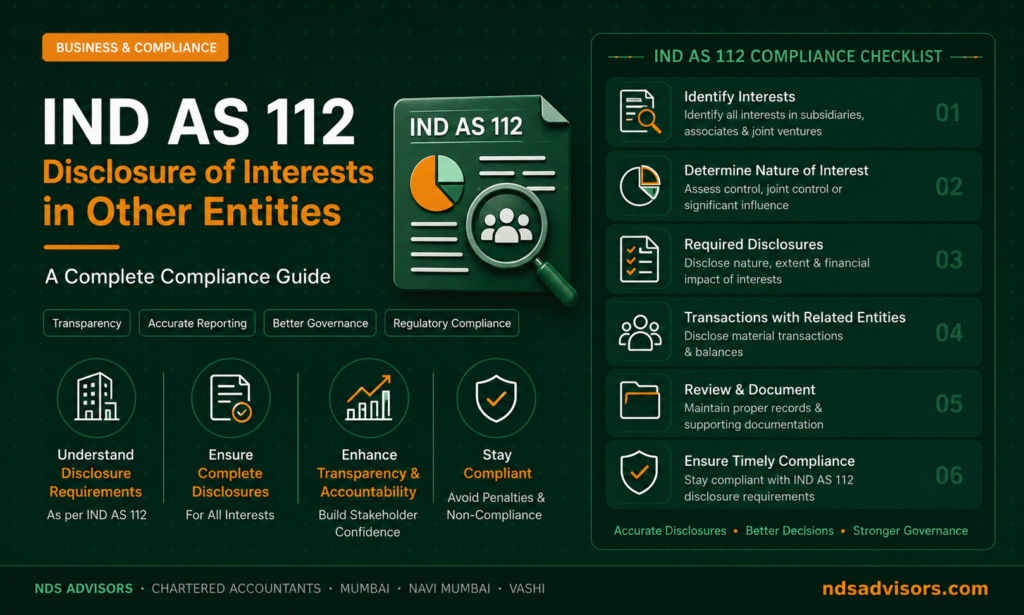
ENTITY INTEREST TYPES — IND AS 112 Reporting Entity Sub- sidiaries Joint Ventures Asso- ciates Structured Entities Full consol. Equity method Equity method Off-balance Ind AS 110 Ind AS 111/28 Ind AS 28 App. A GOVERNED BY: IND AS 112 (= IFRS 12) AUDIT & ASSURANCE Ind AS 112: Disclosure of Interests in Other Entities Subsidiaries · JVs · Associates · Structured Entities SEBI LODR Implications · Judgment Disclosures 5 Entity types 4 Judgment areas 7 Common gaps COVERAGE SCOPE Subsidiaries / NCI JVs & Associates Structured Entities CA Nainit Savla · Founder, NDS Advisors NDS ADVISORS · CHARTERED ACCOUNTANTS Ind AS 112 (Disclosure of Interests in Other Entities) is the standard that tells investors, analysts, lenders, and regulators what a company’s consolidated financial statements do not immediately show: which entities are in the group and why, what restrictions exist on moving assets between group members, how significant the non-controlling interests are in each material subsidiary, what the company’s exposure is to off-balance-sheet structured entities, and what significant judgments management has made in deciding who to consolidate and who to leave out. For listed Indian companies, Ind AS 112 compliance intersects directly with SEBI LODR obligations — the definition of subsidiaries, material subsidiaries, and associates that drives quarterly disclosure obligations, related party transaction reporting, and audit committee review responsibilities flows directly from the Ind AS 110, 111, and 28 framework that Ind AS 112 requires to be disclosed. Getting Ind AS 112 disclosure wrong is therefore not just an accounting standards compliance gap — it can create gaps in regulatory disclosures to stock exchanges. What Is Ind AS 112 and Why Does It Matter? Before the introduction of Ind AS 112 (the Indian equivalent of IFRS 12), disclosure requirements for a company’s interests in other entities were scattered across multiple standards — separate requirements existed for subsidiaries, associates, joint ventures, and off-balance-sheet vehicles, often with inconsistent levels of detail. The result was that a sophisticated investor or lender could read a set of consolidated financial statements without getting a clear picture of the full network of entities the reporting company was involved with, or the risks and restrictions attached to those relationships. The overriding objective of Ind AS 112: to enable users of financial statements to evaluate the nature, extent, and financial effects of the reporting entity’s interests in other entities — and the risks associated with those interests. The standard applies to all entities preparing Ind AS financial statements that have interests in subsidiaries, joint arrangements, associates, or unconsolidated structured entities. For companies that are in the process of or have recently completed Ind AS implementation, the notes required under Ind AS 112 often represent the largest increase in disclosure volume compared to previous Indian GAAP financial statements — particularly for groups with complex ownership structures, offshore entities, or structured financing arrangements. The Five Entity Types Covered Under Ind AS 112 Ind AS 112 covers disclosures for five distinct types of interests. A common mistake is to provide a single combined disclosure for all interests without the entity-type-specific details that the standard requires. Entity Type Relationship Basis Accounting Method Key Ind AS Subsidiaries Control — Ind AS 110 Full consolidation Ind AS 110 Joint Operations Joint control; rights to assets / obligations for liabilities Line-by-line (own share) Ind AS 111 Joint Ventures Joint control; rights to net assets Equity method Ind AS 111 + 28 Associates Significant influence (typically 20–50%) Equity method Ind AS 28 Unconsolidated Structured Entities Interest but not control Off-balance-sheet disclosure Ind AS 112 App. A The Judgment Disclosures — The Most Critical Requirement The most distinctive — and most commonly deficient — aspect of Ind AS 112 is its requirement to disclose significant judgments and assumptions used in determining the nature of interests in other entities. These are not boilerplate disclosures — they must explain the specific reasoning applied in situations where the answer is not obvious from the numbers alone. 1Control Without Majority Voting Rights (De Facto Control) Ind AS 110 defines control on a principles basis: an investor controls an investee when it has power over the investee, exposure to variable returns, and the ability to use its power to affect those returns. This means control can exist with less than 50 percent of the voting rights where, for example, the remaining shares are widely dispersed and in practice the company has always obtained the votes needed to pass resolutions. Where a company consolidates an entity with less than a majority of the voting rights — on the basis of de facto control — Ind AS 112 requires explicit disclosure of the basis for that conclusion: the number of voting rights held, how they compare to the dispersion of remaining rights, and why in practice the company has power over the relevant activities. 2Significant Influence Assessments The 20 percent ownership threshold for significant influence under Ind AS 28 is a rebuttable presumption — it can be overcome in either direction. A company may have significant influence with less than 20 percent if it has board representation, participates in policy decisions, or conducts material intercompany transactions. Equally, a company may hold 25 percent of voting rights but have no practical ability to influence the investee. Ind AS 112 requires disclosure of the basis for the significant influence conclusion in either direction — where influence is asserted below the 20 percent threshold, or where the absence of influence is concluded above it. These disclosures are frequently missing or insufficiently specific in practice. 3Joint Operation vs Joint Venture Classification The classification of a joint arrangement as a joint operation versus a joint venture depends on the rights and obligations of the parties — specifically whether they have direct rights to the assets and direct obligations for the liabilities. The legal form of the arrangement and its contractual terms must both be considered. Where a joint arrangement is conducted through a separate legal entity but is classified as a joint operation based on contractual terms that

Ind AS 112: Disclosure of Interests in Other Entities — A Complete Compliance Guide Read More »
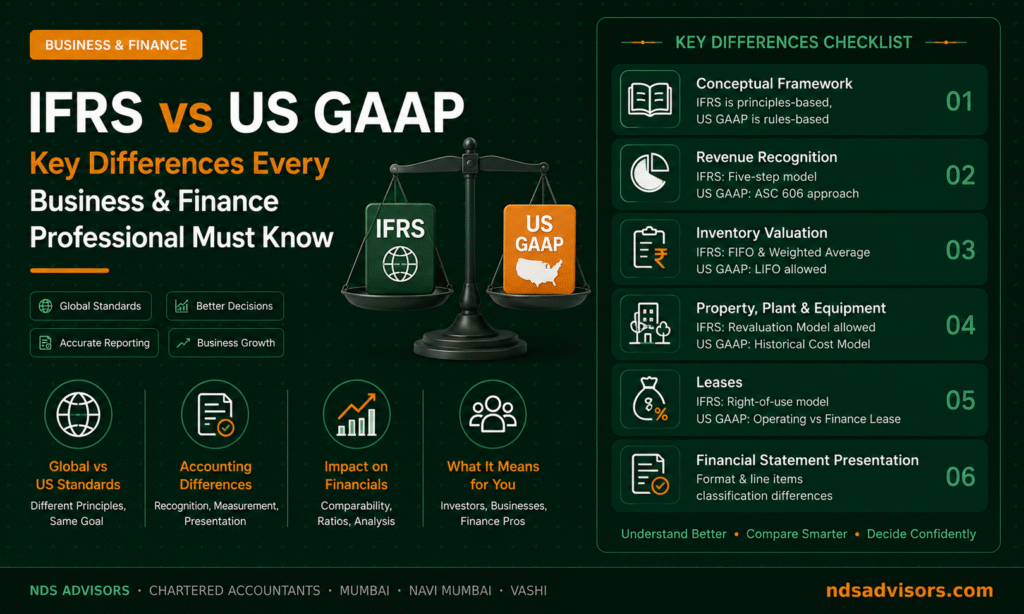
IFRS vs US GAAP: Key Differences Every Business and Finance Professional Must Know

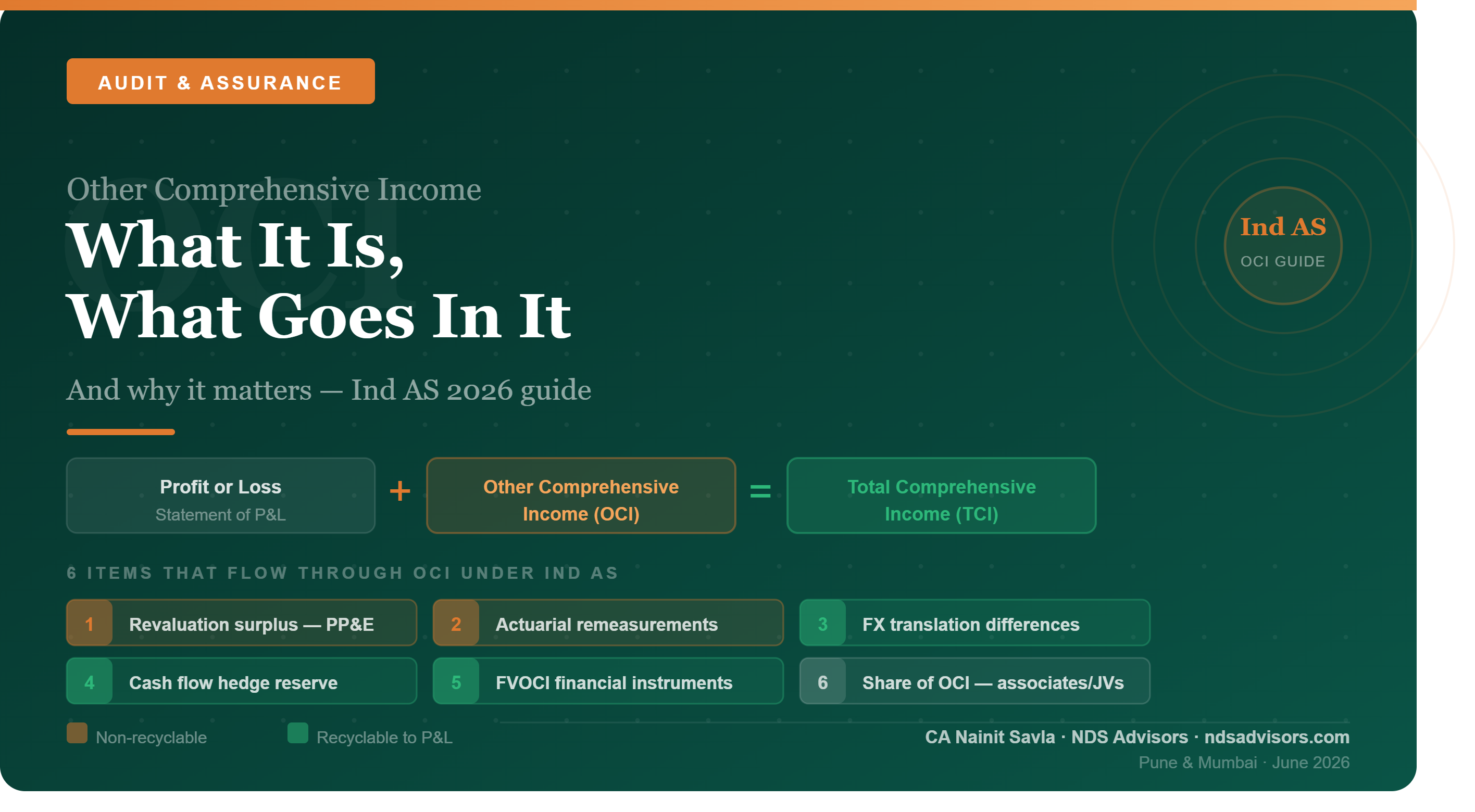
TOTAL COMPREHENSIVE INCOME Profit or Loss Statement of P&L + Other Comprehensive Income Bypasses P&L → directly to equity = Total Comprehensive Income Ind AS 1 — complete performance measure AUDIT & ASSURANCE Other Comprehensive Income (OCI) What it is · What goes in it · Why it matters 6 OCI items 3 Recyclable 3 Non-recyclable OCI CLASSIFICATION Recyclable to P&L Non-recyclable (permanent) CA Nainit Savla · Founder, NDS Advisors ndsadvisors.com · Pune & Mumbai · June 2026 NDS ADVISORS · CHARTERED ACCOUNTANTS When investors and finance professionals read an Indian company’s Ind AS financial statements for the first time, Other Comprehensive Income (OCI) is often the section that generates the most confusion. A company can report a healthy profit for the year on the face of the statement of profit and loss, yet arrive at a negative Total Comprehensive Income once OCI is factored in — or conversely, show a significantly higher Total Comprehensive Income because of large positive OCI items. Understanding other comprehensive income is not optional for anyone involved in preparing, auditing, or analysing Ind AS financial statements. What Is Other Comprehensive Income? In accounting, income and expense items can be recognised in one of two places: in the statement of profit and loss (P&L), or in Other Comprehensive Income (OCI). Both routes ultimately affect equity on the balance sheet — but they take different paths to get there. P&L items flow through the bottom line — profit or loss — and from there into retained earnings in equity. OCI items bypass P&L entirely and go directly into specific reserves in equity, without passing through the profit line. Under Ind AS 1, Total Comprehensive Income (TCI) = Profit or Loss + Other Comprehensive Income. TCI represents the total change in equity during the period from all transactions and events other than those with owners. What Goes Into OCI Under Ind AS? All Items Explained 1. Revaluation Surplus on Property, Plant and Equipment — Ind AS 16 When a company chooses the revaluation model for PP&E under Ind AS 16, increases in fair value above the previous carrying amount are recognised in OCI and accumulated in a revaluation surplus in equity. Subsequent decreases are first offset against any existing revaluation surplus, with excess recognised in P&L. The revaluation surplus may be transferred directly to retained earnings as the asset is used — but it is never reclassified to P&L. This makes it a permanent OCI item. 2. Remeasurements of Defined Benefit Plans — Ind AS 19 Under Ind AS 19, when actual experience differs from actuarial assumptions — discount rates, salary escalation rates, mortality tables — the resulting actuarial gains and losses are recognised in OCI. These remeasurements are never reclassified to P&L. For companies with large workforces and significant gratuity or pension obligations, a sharp fall in the discount rate can produce a large actuarial loss in OCI that directly reduces equity — even while profits remain positive. 3. Foreign Currency Translation Differences — Ind AS 21 When a company has foreign operations, their financial statements are translated into the group’s presentation currency for consolidation. Exchange differences arising on translation are recognised in OCI and accumulated in a Foreign Currency Translation Reserve (FCTR). Unlike revaluation surplus, foreign currency translation differences are recyclable OCI — they are reclassified from OCI to P&L when the foreign operation is disposed of. 4. Effective Portion of Cash Flow Hedges — Ind AS 109 When a company designates a hedging instrument in a qualifying cash flow hedge relationship, the effective portion of gains and losses on the hedging instrument is recognised in OCI in a cash flow hedge reserve. This is recyclable OCI. When the hedged future transaction occurs and affects P&L, the related amount in the cash flow hedge reserve is reclassified from OCI to P&L — matching the hedge instrument gain/loss with the hedged item’s P&L impact. 5. Fair Value Changes on Financial Instruments at FVOCI — Ind AS 109 Under Ind AS 109, certain financial instruments are classified at Fair Value Through Other Comprehensive Income (FVOCI): Debt instruments at FVOCI — fair value changes accumulate in OCI and are reclassified to P&L when sold or impaired — recyclable OCI Equity instruments designated at FVOCI — fair value changes accumulate in OCI but are never reclassified to P&L when sold — permanently non-recyclable OCI. Only dividends go to P&L 6. Share of OCI of Associates and Joint Ventures — Ind AS 28 When a company uses the equity method for associates and joint ventures, its share of their OCI is also recognised in the investor’s own OCI — in the same category (recyclable or non-recyclable) as it would be if directly recognised by the investor. Recyclable vs Non-Recyclable OCI: The Critical Distinction Ind AS 1 requires OCI to be split into two groups based on whether items will or will not subsequently be reclassified to profit or loss. This split must be presented on the face of the financial statements. ✓ Recyclable to P&L Foreign currency translation differences (on disposal of foreign operation) Effective portion of cash flow hedges (when hedged item hits P&L) Debt instruments at FVOCI (on sale or impairment) ✕ Non-Recyclable (permanent equity) Revaluation surplus on PP&E (Ind AS 16) Actuarial remeasurements of defined benefit plans (Ind AS 19) Equity instruments designated at FVOCI (Ind AS 109) OCI Item Recyclable to P&L? Governing Ind AS Revaluation surplus — PP&E No — permanent Ind AS 16 Actuarial remeasurements — defined benefit plans No — permanent Ind AS 19 Equity instruments at FVOCI No — no recycling on sale Ind AS 109 Foreign currency translation differences Yes — on disposal Ind AS 21 Effective portion of cash flow hedges Yes — when hedged item hits P&L Ind AS 109 Debt instruments at FVOCI Yes — on sale or impairment Ind AS 109 Share of OCI of associates / JVs Follows category of underlying item Ind AS 28 How OCI Is Presented in Ind AS Financial Statements Under Ind

IFRS vs US GAAP: Key Differences Every Business and Finance Professional Must Know Read More »

Other Comprehensive Income (OCI): What It Is, What Goes In It, and Why It Matters

TOTAL COMPREHENSIVE INCOME Profit or Loss Statement of P&L + Other Comprehensive Income Bypasses P&L → directly to equity = Total Comprehensive Income Ind AS 1 — complete performance measure AUDIT & ASSURANCE Other Comprehensive Income (OCI) What it is · What goes in it · Why it matters 6 OCI items 3 Recyclable 3 Non-recyclable OCI CLASSIFICATION Recyclable to P&L Non-recyclable (permanent) CA Nainit Savla · Founder, NDS Advisors ndsadvisors.com · Pune & Mumbai · June 2026 NDS ADVISORS · CHARTERED ACCOUNTANTS When investors and finance professionals read an Indian company’s Ind AS financial statements for the first time, Other Comprehensive Income (OCI) is often the section that generates the most confusion. A company can report a healthy profit for the year on the face of the statement of profit and loss, yet arrive at a negative Total Comprehensive Income once OCI is factored in — or conversely, show a significantly higher Total Comprehensive Income because of large positive OCI items. Understanding other comprehensive income is not optional for anyone involved in preparing, auditing, or analysing Ind AS financial statements. What Is Other Comprehensive Income? In accounting, income and expense items can be recognised in one of two places: in the statement of profit and loss (P&L), or in Other Comprehensive Income (OCI). Both routes ultimately affect equity on the balance sheet — but they take different paths to get there. P&L items flow through the bottom line — profit or loss — and from there into retained earnings in equity. OCI items bypass P&L entirely and go directly into specific reserves in equity, without passing through the profit line. Under Ind AS 1, Total Comprehensive Income (TCI) = Profit or Loss + Other Comprehensive Income. TCI represents the total change in equity during the period from all transactions and events other than those with owners. What Goes Into OCI Under Ind AS? All Items Explained 1. Revaluation Surplus on Property, Plant and Equipment — Ind AS 16 When a company chooses the revaluation model for PP&E under Ind AS 16, increases in fair value above the previous carrying amount are recognised in OCI and accumulated in a revaluation surplus in equity. Subsequent decreases are first offset against any existing revaluation surplus, with excess recognised in P&L. The revaluation surplus may be transferred directly to retained earnings as the asset is used — but it is never reclassified to P&L. This makes it a permanent OCI item. 2. Remeasurements of Defined Benefit Plans — Ind AS 19 Under Ind AS 19, when actual experience differs from actuarial assumptions — discount rates, salary escalation rates, mortality tables — the resulting actuarial gains and losses are recognised in OCI. These remeasurements are never reclassified to P&L. For companies with large workforces and significant gratuity or pension obligations, a sharp fall in the discount rate can produce a large actuarial loss in OCI that directly reduces equity — even while profits remain positive. 3. Foreign Currency Translation Differences — Ind AS 21 When a company has foreign operations, their financial statements are translated into the group’s presentation currency for consolidation. Exchange differences arising on translation are recognised in OCI and accumulated in a Foreign Currency Translation Reserve (FCTR). Unlike revaluation surplus, foreign currency translation differences are recyclable OCI — they are reclassified from OCI to P&L when the foreign operation is disposed of. 4. Effective Portion of Cash Flow Hedges — Ind AS 109 When a company designates a hedging instrument in a qualifying cash flow hedge relationship, the effective portion of gains and losses on the hedging instrument is recognised in OCI in a cash flow hedge reserve. This is recyclable OCI. When the hedged future transaction occurs and affects P&L, the related amount in the cash flow hedge reserve is reclassified from OCI to P&L — matching the hedge instrument gain/loss with the hedged item’s P&L impact. 5. Fair Value Changes on Financial Instruments at FVOCI — Ind AS 109 Under Ind AS 109, certain financial instruments are classified at Fair Value Through Other Comprehensive Income (FVOCI): Debt instruments at FVOCI — fair value changes accumulate in OCI and are reclassified to P&L when sold or impaired — recyclable OCI Equity instruments designated at FVOCI — fair value changes accumulate in OCI but are never reclassified to P&L when sold — permanently non-recyclable OCI. Only dividends go to P&L 6. Share of OCI of Associates and Joint Ventures — Ind AS 28 When a company uses the equity method for associates and joint ventures, its share of their OCI is also recognised in the investor’s own OCI — in the same category (recyclable or non-recyclable) as it would be if directly recognised by the investor. Recyclable vs Non-Recyclable OCI: The Critical Distinction Ind AS 1 requires OCI to be split into two groups based on whether items will or will not subsequently be reclassified to profit or loss. This split must be presented on the face of the financial statements. ✓ Recyclable to P&L Foreign currency translation differences (on disposal of foreign operation) Effective portion of cash flow hedges (when hedged item hits P&L) Debt instruments at FVOCI (on sale or impairment) ✕ Non-Recyclable (permanent equity) Revaluation surplus on PP&E (Ind AS 16) Actuarial remeasurements of defined benefit plans (Ind AS 19) Equity instruments designated at FVOCI (Ind AS 109) OCI Item Recyclable to P&L? Governing Ind AS Revaluation surplus — PP&E No — permanent Ind AS 16 Actuarial remeasurements — defined benefit plans No — permanent Ind AS 19 Equity instruments at FVOCI No — no recycling on sale Ind AS 109 Foreign currency translation differences Yes — on disposal Ind AS 21 Effective portion of cash flow hedges Yes — when hedged item hits P&L Ind AS 109 Debt instruments at FVOCI Yes — on sale or impairment Ind AS 109 Share of OCI of associates / JVs Follows category of underlying item Ind AS 28 How OCI Is Presented in Ind AS Financial Statements Under Ind

Other Comprehensive Income (OCI): What It Is, What Goes In It, and Why It Matters Read More »