
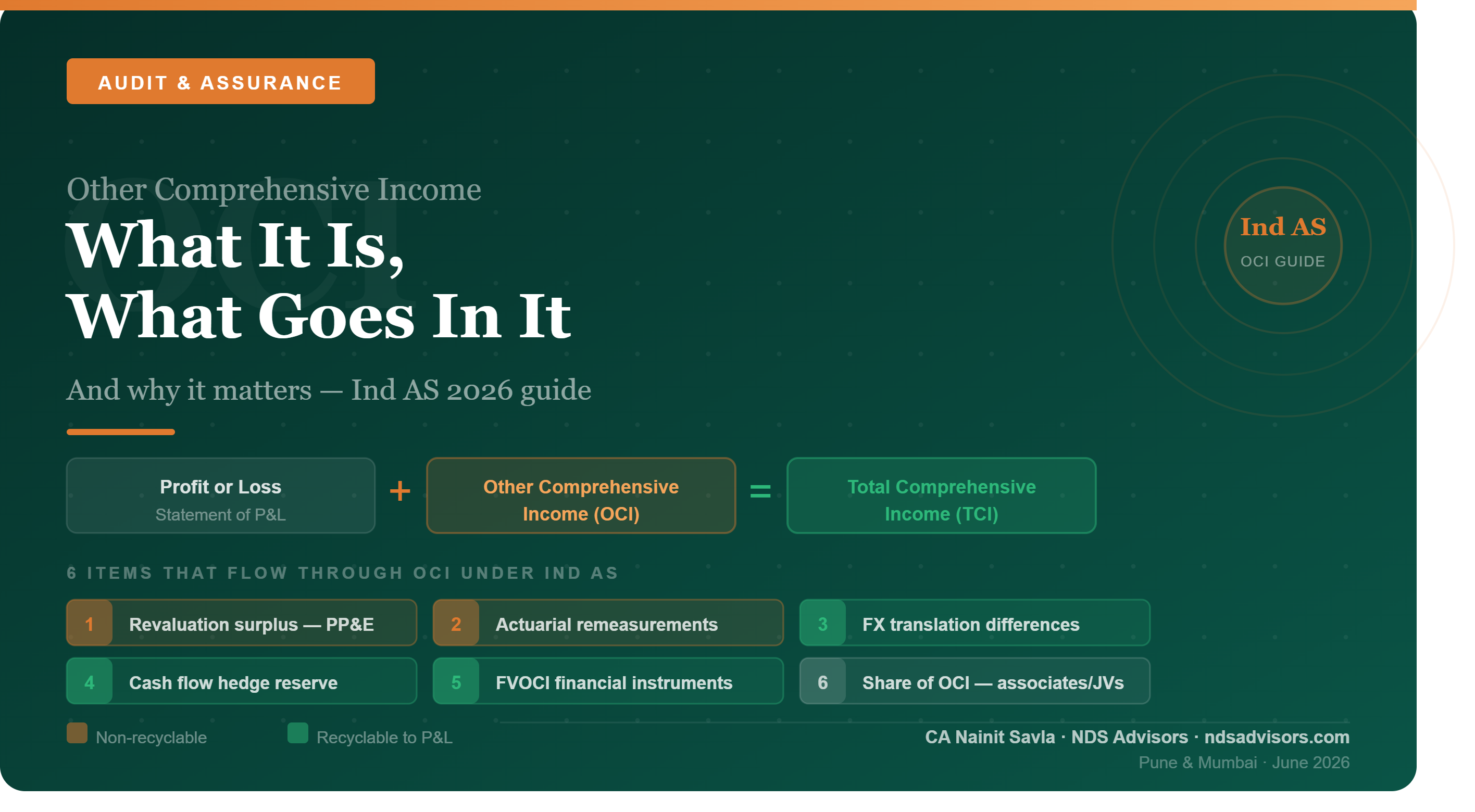
When investors and finance professionals read an Indian company's Ind AS financial statements for the first time, Other Comprehensive Income (OCI) is often the section that generates the most confusion. A company can report a healthy profit for the year on the face of the statement of profit and loss, yet arrive at a negative Total Comprehensive Income once OCI is factored in — or conversely, show a significantly higher Total Comprehensive Income because of large positive OCI items. Understanding other comprehensive income is not optional for anyone involved in preparing, auditing, or analysing Ind AS financial statements.
What Is Other Comprehensive Income?
In accounting, income and expense items can be recognised in one of two places: in the statement of profit and loss (P&L), or in Other Comprehensive Income (OCI). Both routes ultimately affect equity on the balance sheet — but they take different paths to get there.
OCI items bypass P&L entirely and go directly into specific reserves in equity, without passing through the profit line. Under Ind AS 1, Total Comprehensive Income (TCI) = Profit or Loss + Other Comprehensive Income. TCI represents the total change in equity during the period from all transactions and events other than those with owners.
What Goes Into OCI Under Ind AS? All Items Explained
1. Revaluation Surplus on Property, Plant and Equipment — Ind AS 16
When a company chooses the revaluation model for PP&E under Ind AS 16, increases in fair value above the previous carrying amount are recognised in OCI and accumulated in a revaluation surplus in equity. Subsequent decreases are first offset against any existing revaluation surplus, with excess recognised in P&L. The revaluation surplus may be transferred directly to retained earnings as the asset is used — but it is never reclassified to P&L. This makes it a permanent OCI item.
2. Remeasurements of Defined Benefit Plans — Ind AS 19
Under Ind AS 19, when actual experience differs from actuarial assumptions — discount rates, salary escalation rates, mortality tables — the resulting actuarial gains and losses are recognised in OCI. These remeasurements are never reclassified to P&L. For companies with large workforces and significant gratuity or pension obligations, a sharp fall in the discount rate can produce a large actuarial loss in OCI that directly reduces equity — even while profits remain positive.
3. Foreign Currency Translation Differences — Ind AS 21
When a company has foreign operations, their financial statements are translated into the group's presentation currency for consolidation. Exchange differences arising on translation are recognised in OCI and accumulated in a Foreign Currency Translation Reserve (FCTR). Unlike revaluation surplus, foreign currency translation differences are recyclable OCI — they are reclassified from OCI to P&L when the foreign operation is disposed of.
4. Effective Portion of Cash Flow Hedges — Ind AS 109
When a company designates a hedging instrument in a qualifying cash flow hedge relationship, the effective portion of gains and losses on the hedging instrument is recognised in OCI in a cash flow hedge reserve. This is recyclable OCI. When the hedged future transaction occurs and affects P&L, the related amount in the cash flow hedge reserve is reclassified from OCI to P&L — matching the hedge instrument gain/loss with the hedged item's P&L impact.
5. Fair Value Changes on Financial Instruments at FVOCI — Ind AS 109
Under Ind AS 109, certain financial instruments are classified at Fair Value Through Other Comprehensive Income (FVOCI):
- Debt instruments at FVOCI — fair value changes accumulate in OCI and are reclassified to P&L when sold or impaired — recyclable OCI
- Equity instruments designated at FVOCI — fair value changes accumulate in OCI but are never reclassified to P&L when sold — permanently non-recyclable OCI. Only dividends go to P&L
6. Share of OCI of Associates and Joint Ventures — Ind AS 28
When a company uses the equity method for associates and joint ventures, its share of their OCI is also recognised in the investor's own OCI — in the same category (recyclable or non-recyclable) as it would be if directly recognised by the investor.
Recyclable vs Non-Recyclable OCI: The Critical Distinction
Ind AS 1 requires OCI to be split into two groups based on whether items will or will not subsequently be reclassified to profit or loss. This split must be presented on the face of the financial statements.
✓ Recyclable to P&L
- Foreign currency translation differences (on disposal of foreign operation)
- Effective portion of cash flow hedges (when hedged item hits P&L)
- Debt instruments at FVOCI (on sale or impairment)
✕ Non-Recyclable (permanent equity)
- Revaluation surplus on PP&E (Ind AS 16)
- Actuarial remeasurements of defined benefit plans (Ind AS 19)
- Equity instruments designated at FVOCI (Ind AS 109)
| OCI Item | Recyclable to P&L? | Governing Ind AS |
|---|---|---|
| Revaluation surplus — PP&E | No — permanent | Ind AS 16 |
| Actuarial remeasurements — defined benefit plans | No — permanent | Ind AS 19 |
| Equity instruments at FVOCI | No — no recycling on sale | Ind AS 109 |
| Foreign currency translation differences | Yes — on disposal | Ind AS 21 |
| Effective portion of cash flow hedges | Yes — when hedged item hits P&L | Ind AS 109 |
| Debt instruments at FVOCI | Yes — on sale or impairment | Ind AS 109 |
| Share of OCI of associates / JVs | Follows category of underlying item | Ind AS 28 |
How OCI Is Presented in Ind AS Financial Statements
Under Ind AS 1 and Schedule III Division II of the Companies Act 2013, OCI can be presented in two ways:
- Single combined statement — showing profit for the period, followed by OCI items, with the total being Total Comprehensive Income. This is the more common presentation among Indian listed companies
- Two separate statements — a Statement of Profit and Loss ending at profit or loss, and a separate Statement of Other Comprehensive Income adding OCI items to arrive at TCI
Regardless of format, the OCI section must separately present each line item, classify items into recyclable and non-recyclable, show the deferred tax effect of each OCI item within OCI, and show reclassification adjustments separately where applicable.
Deferred Tax on OCI — A Commonly Misunderstood Area
Most OCI items create temporary differences between their accounting carrying amount and their tax base. The key rule under Ind AS 12 is that the deferred tax effect of an OCI item must be presented in OCI — not in the income tax line of P&L. Each gross OCI item is accompanied by its deferred tax effect, and the OCI section shows the net amount after deferred tax.
Revaluation surplus on PP&E → creates a deferred tax liability in OCI · Actuarial loss on defined benefit plan → creates a deferred tax asset in OCI · Fair value gains on debt FVOCI → deferred tax liability in OCI · Negative translation differences → may create deferred tax if temporary difference reverses on disposal
For companies undergoing Ind AS implementation for the first time, correctly computing and presenting deferred tax on OCI is one of the most frequent areas where adjustments are required during the first-year audit.
Why OCI Matters for Financial Analysis and Business Decisions
Net worth and equity ratios
OCI items flow directly into equity, directly affecting net worth, book value per share, and equity-based ratios such as Return on Equity (ROE) and Debt-to-Equity. A company that consistently shows large negative OCI — due to actuarial losses or negative translation differences — can see its equity eroded even while reporting accounting profits year after year.
Total Comprehensive Income vs Profit
A company with Rs. 50 crore profit and Rs. 80 crore negative OCI has a negative TCI of Rs. 30 crore — meaning net worth declined despite a positive profit line. This disconnect is common in companies with large defined benefit obligations or significant foreign currency exposures.
Loan covenants and regulatory capital
Many loan agreements include financial covenants based on net worth, equity, or debt-to-equity ratios. Large negative OCI movements — particularly PP&E revaluations going into reverse, or pension obligations in volatile interest rate environments — can trigger covenant breaches even without any change in the P&L profit figure. Finance teams must monitor OCI as carefully as they monitor P&L.
Investor and analyst communication
For listed companies, the OCI section provides investors with transparency on value changes that management did not choose to recognise in P&L. Sophisticated equity analysts examine OCI to assess the sustainability of reported profits, unrealised gains or losses sitting in equity, and whether recyclable OCI items are likely to reclassify to P&L in ways that will affect future reported profit.
Frequently Asked Questions
What is Other Comprehensive Income (OCI)?
What is the difference between profit and Total Comprehensive Income?
Which OCI items are recyclable and which are not?
How is OCI presented in Ind AS financial statements?
Does OCI affect the income tax liability of a company?
What happens to OCI items when they are reclassified to profit or loss?
CA Nainit Savla
Founder, NDS Advisors · Pune & Mumbai
Specialist in Ind AS / IFRS implementation, audit & assurance, and international tax advisory.