
Almost every article on this subject is a ranked list. Number one, number two, number three, a table of features, a verdict. The difficulty is that the ranking is meaningless without knowing the business, because the software that is genuinely excellent for a Bandra design consultancy is close to useless for a Vashi trading firm carrying two thousand stock items.
So this guide is organised the other way round. It starts with what your business is obliged to do, works out what that forces the software to handle, and only then looks at what is available. That order matters, because the compliance obligations are not negotiable and the software preferences are.
- There is no single best accounting software for Indian small businesses. There is only the software that matches your turnover, your compliance obligations and the way your business actually moves goods or bills clients.
- Compliance thresholds, not features, should drive the shortlist. Crossing the e-invoicing threshold changes what your software must be able to do, whatever you thought of it before.
- TallyPrime and Zoho Books cover most of the market between them — broadly, desktop and inventory-heavy on one side, cloud and service-business on the other.
- QuickBooks is not an option in India. Intuit stopped new sign-ups in 2022 and existing Indian users lost access in 2023, yet it still appears in comparison articles and vendor lists.
- Whether your accountant can work in the software matters more than any feature comparison. Software your CA cannot open becomes a monthly export-and-email exercise.
- Migration cost is the real switching cost. Opening balances, ledger masters, stock and GST history all have to move, which is why the choice is worth getting right early.
Start With the Thresholds, Not the Shortlist
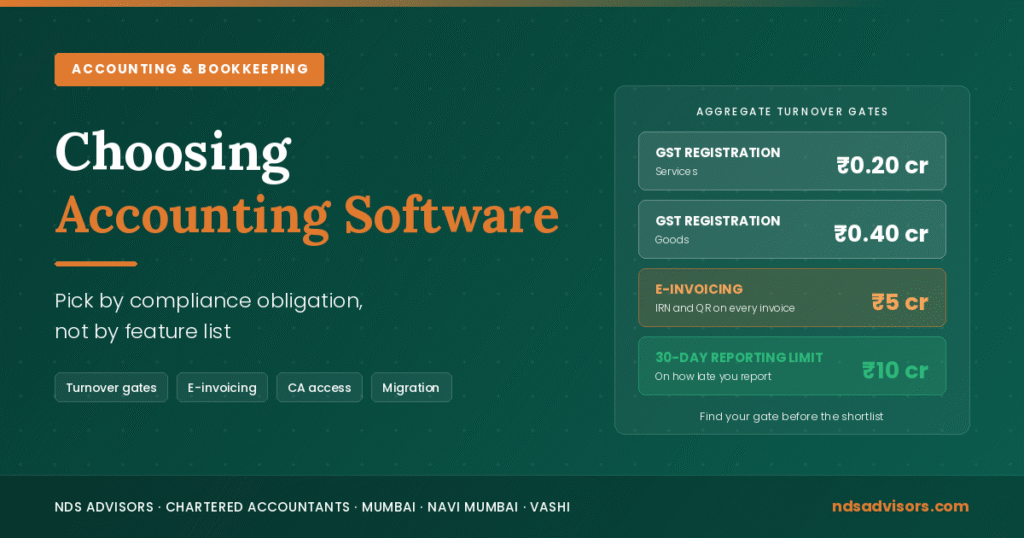
Four numbers determine most of what your accounting system has to be capable of. Find where your business sits against them before looking at a single product page.
Thresholds are based on aggregate annual turnover and are those generally applicable; special category states apply lower GST registration limits, and specific categories are required to register irrespective of turnover. Thresholds have been revised more than once — confirm the current position on the GST portal before relying on them.
The shape of that chart is the point. Nothing much changes between the registration thresholds and ₹5 crore — a competent billing package will cope. At ₹5 crore the requirement changes in kind rather than degree, because invoices must now be reported to the invoice registration portal and carry an IRN and QR code before they are valid. Software that cannot do that stops being a preference and becomes a blocker.
Two further obligations sit alongside these and are easy to overlook:
- E-way bills are required for consignments above the prescribed value, so any business moving goods needs the software to generate them without a separate portal exercise.
- TDS obligations arise regardless of turnover in many cases, and a system that cannot track deduction, deposit and return data will push that work back onto spreadsheets.
What Is Actually Available, and Who Each Option Suits
The Indian market has consolidated around a handful of serious options for small businesses, plus a long tail of mobile-first billing apps. This is not a ranking — the right-hand column is the part that matters.
| Software | Type | Suits | Watch for |
|---|---|---|---|
| TallyPrime | Desktop, with remote access options | Trading, manufacturing and distribution; inventory-heavy businesses; anywhere your accountant and auditor expect Tally data | Multi-location and remote working need deliberate setup rather than being the default |
| Zoho Books | Cloud | Service businesses, consultancies, agencies and startups; multi-user access; businesses wanting automation and integrations | Deep inventory and manufacturing needs may outgrow it or need add-on modules |
| Busy | Desktop | Trading and distribution, particularly where dealer or scheme management matters | Cloud access is not its native strength |
| Marg ERP | Desktop | Pharmaceutical and FMCG distribution, where batch and expiry tracking is essential | Highly specialised; less suited outside those verticals |
| Vyapar and similar mobile-first apps | Mobile and desktop | Micro businesses, retail counters and sole proprietors needing billing and basic books | Reporting depth is limited as you grow; plan the exit early |
| ERPNext | Open source, self-hosted or cloud | Businesses wanting no per-user licence cost and willing to invest in implementation | Needs real implementation effort and someone to maintain it |
| SAP, Oracle, Microsoft Dynamics | Enterprise | Groups with complex consolidation, multi-entity or multi-country needs | Cost and implementation scale are well beyond a small business |
Positioning is based on typical use, not on vendor claims. No vendor has paid for inclusion here. Feature sets and pricing change frequently — check the current plan directly with the vendor before subscribing.
A Correction Worth Making: QuickBooks Left India
This still appears in comparison articles, in vendor round-ups and on the websites of firms that have not revisited their content in a while. It is out of date, and acting on it wastes real time.
- Intuit stopped accepting new QuickBooks sign-ups in India during 2022.
- Existing Indian subscribers were moved to free access for a transition window and then lost access, with the wind-down completing in 2023.
- The withdrawal covered QuickBooks Online, QuickBooks Online Accountant, the mobile app and QuickBooks Time. Intuit’s own India page still carries the notice.
- The reasons were structural rather than temporary — continuous GST localisation, intense domestic price competition, and a strategic decision to concentrate resources elsewhere. None of those has reversed.
Matching the Software to the Business
Once the compliance floor is clear, the choice narrows quickly by business type. These are the patterns we see most often across Mumbai, Navi Mumbai and Vashi.
If you sell services and bill by project or retainer
A cloud package is usually the better fit. Recurring invoices, client portals, expense capture and multi-user access matter more than stock. Zoho Books handles this comfortably, and the fact that it is built in India for Indian tax rules means GST changes arrive without waiting for a global release cycle.
If you buy and sell goods
Inventory becomes the deciding factor, and desktop packages still lead here. Tally, Busy and Marg were built around stock, batch, godown and rate structures in a way that generic cloud tools often approximate rather than genuinely support. If your stock ledger is the heart of your business, choose for that first.
If you are a micro business or just starting
A mobile-first billing app is a reasonable start, provided you treat it as a start. The failure mode is staying on it for four years and then discovering the historical data will not migrate cleanly into anything else. Decide upfront at what turnover you will move.
If you sell online
Marketplace settlements, returns, commissions and TCS make reconciliation the hard part, not invoicing. Whatever you choose must reconcile settlement reports against your books without manual re-keying — which is the substance of what our e-commerce accounting work involves.
If you have overseas operations or a foreign parent
Multi-currency handling and the ability to produce a reporting pack on a second basis become relevant. This is usually where a small business first outgrows an entry-level package.
What Each Obligation Demands From the Software
| Obligation | What the software has to do |
|---|---|
| GST registration and returns | Generate compliant tax invoices, maintain HSN and rate masters, and produce return-ready data reconciled to the portal |
| Input tax credit | Reconcile purchase records against the auto-populated statement and flag mismatches by supplier |
| E-invoicing | Push invoice data to the invoice registration portal and print the IRN and QR code on the invoice before it is issued |
| E-way bills | Generate and update e-way bills from the same invoice data, without re-entering it on a portal |
| TDS | Track deduction at the right rate and section, and produce data for quarterly returns |
| Payroll and statutory dues | Compute salaries, and produce provident fund, ESI and professional tax outputs |
| Statutory audit and tax audit | Export a clean trial balance and ledgers your auditor can work from without reconstruction |
| Books retention | Retain records for the statutory period with the data genuinely recoverable, not locked in a lapsed subscription |
Indicative mapping. Which of these apply to your business depends on turnover, registration status and activity.
Seven Checks Before You Commit
Run these before subscribing. Most switching regret traces back to skipping one of them.
- Confirm your position against every threshold above, using aggregate turnover rather than the figure in your profit and loss account.
- Ask your accountant what they can work in. Software your CA cannot open turns every month-end into an export-and-email routine, and that cost never appears in the subscription price.
- Count the users who genuinely need access, including your accountant, and price on that basis rather than the headline single-user rate.
- Test the GST return output on real data, not the demo file. Whether return-ready data comes out cleanly is the single most useful test you can run.
- Check the export path before you enter. Establish how you would get your ledgers, masters and stock out in a usable format if you left in three years.
- Confirm where the data is stored and who controls the backup, particularly for cloud packages.
- Plan the cutover date. Moving at the start of a financial year is far less painful than mid-year, because opening balances and comparatives line up naturally.
Where the Choice Usually Goes Wrong
- Choosing on monthly price alone. The subscription is rarely the largest cost. Implementation, training, migration and the staff time spent working around gaps usually exceed it in year one.
- Buying capability you will not use for years. Manufacturing and multi-entity modules bought “for later” mostly add complexity now and are outdated by the time later arrives.
- Ignoring the accountant’s workflow. If your books have to be re-keyed at year-end, you have not saved anything — you have moved the work.
- Relying on an outdated recommendation. QuickBooks is the clearest example, but any list more than a year old is worth checking against current availability and pricing.
- Running the books outside the software. Where the real numbers live in a parallel spreadsheet, the software becomes an invoicing tool and the accounts stop being reliable.
- Leaving migration to the last week. Opening balances, ledger masters, stock valuation and GST history all have to move and reconcile. It is a project, not an afternoon.
How NDS Advisors Helps
We are software-agnostic by design — we work in whatever our clients run, which means we see where each package holds up and where it does not. Details of the practice are on our bookkeeping overview page.
- We size the requirement against your actual compliance position before recommending anything, so you are not paying for capability you will never use.
- For businesses that would rather not run the system at all, our outsourced bookkeeping and outsourced accounting in Mumbai teams operate it end to end and deliver the reporting.
- Where e-invoicing is the trigger, we handle the setup and the ongoing GST return filing so that invoice data and returns reconcile from the outset.
- Monthly reporting is where software choice pays off or does not — our financial reporting and MIS service turns whatever you run into numbers a management team can use.
Frequently Asked Questions
Which accounting software is best for a small business in India?
Is QuickBooks available in India?
At what turnover does e-invoicing become compulsory?
Do I need paid software, or will a free tool do?
How difficult is it to switch accounting software later?
The bottom line
The best accounting software for your business is the one that produces return-ready data, handles the specific obligations your turnover triggers, and can be opened by the person who has to sign off your accounts. Work out those three requirements first and the shortlist writes itself. Start from a ranked list instead, and you are choosing someone else’s answer to a question about your business.
Suit No. 102, L1, Ashok Premises, Nicholas Road, Andheri (East), Mumbai 400069 · Mon–Sat, 10:00 AM – 7:00 PM
Written by the accounting team at NDS Advisors, Chartered Accountants
Mumbai · Navi Mumbai · Vashi
We work across Tally, Zoho Books, Busy, Marg and enterprise systems for clients in Mumbai, Navi Mumbai and Vashi, and hold no reseller or affiliate arrangement with any vendor named above. Product features, pricing and statutory thresholds change frequently — verify the current position before making a decision.