
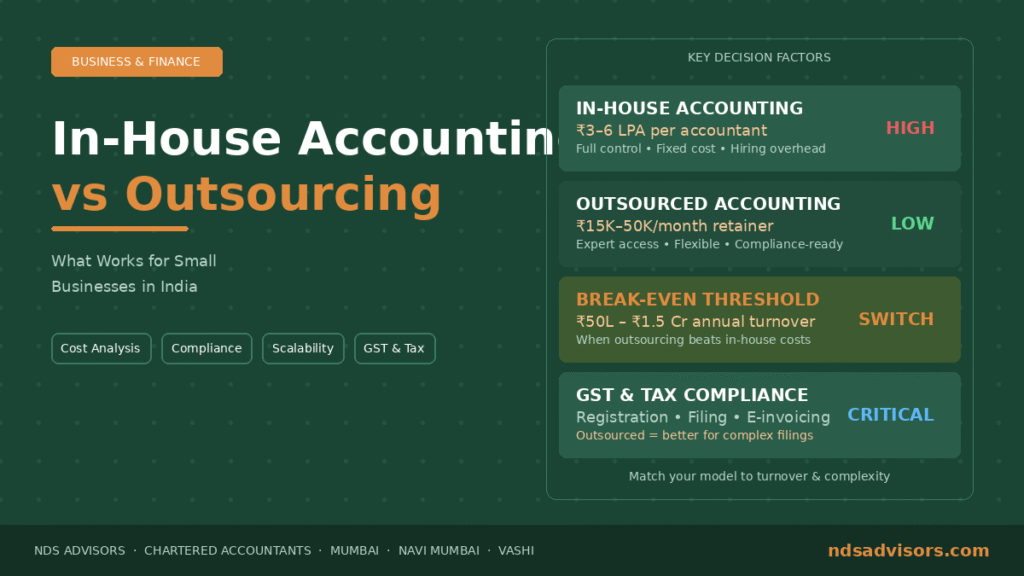
Every small business owner in India faces the same question at some point: should you build your own accounting team, or hand the numbers over to an external firm? Hire the wrong person in-house, and you face salary costs, PF, ESIC, and the risk of a single point of failure when they resign. Outsource to the wrong firm, and you might get late filings, poor communication, and no one who truly understands your business. The right answer depends on the size of your business, the complexity of your transactions, your compliance obligations, and your growth trajectory.
NDS Advisors is a leading Chartered Accountant firm headquartered in Andheri East, Mumbai, serving businesses across Mumbai, Navi Mumbai, Vashi, and Pune. With 15+ years of experience and a team of 75+ qualified professionals, we work with startups, MSMEs, and growing enterprises across sectors including manufacturing, retail, real estate, healthcare, jewellery, textiles, and IT services. This guide walks you through everything you need to know about the in-house vs outsourcing decision — the real costs, the hidden risks, and the practical framework for making the right call for your business stage.
- The full cost of an in-house accountant is 40–60% higher than the salary alone once you load PF, ESIC, gratuity, leave encashment and recruitment.
- Outsourced accounting typically costs ₹1.8–3.6 lakh per year for a small business, against ₹3.5–5.5 lakh for a junior in-house hire — before attrition and skill-gap risks.
- Early-stage businesses (₹0–5 crore) almost always benefit from outsourcing because the compliance load is manageable by a CA firm and the cost gap is widest.
- High-transaction or operationally complex businesses — retail chains, jewellery manufacturers, construction — may need in-house capacity supported by external compliance expertise.
- The hybrid model — a junior in-house bookkeeper plus an outsourced CA firm for compliance and advisory — is often the best fit for businesses in the ₹5–15 crore range.
What Does Accounting for a Small Business in India Actually Involve?
Before comparing in-house and outsourcing, it helps to be precise about what “accounting” covers. The scope is wider than most business owners realise:
- Day-to-day bookkeeping — recording sales, purchases, payments, receipts, and journal entries in a system like Tally or Zoho Books.
- Bank reconciliation — matching your bank statements with your books every month to catch errors and missing entries.
- GST compliance — filing GSTR-1 and GSTR-3B every month (or quarterly under QRMP), reconciling GSTR-2B for ITC claims, and filing the annual GSTR-9.
- TDS compliance — deducting TDS at the correct rates on applicable payments, filing quarterly TDS returns (Form 24Q, 26Q), and generating Form 16 / 16A.
- Income tax filing — preparing and filing the annual ITR, computing advance tax liability, and handling any notices from the Income Tax Department.
- Payroll processing — calculating salaries, deducting PF, ESIC, and professional tax, and maintaining compliance with the EPF Act, 1952.
- Financial reporting — preparing monthly P&L, balance sheet, and cash flow statements so you have real visibility into performance.
- Statutory audit support — maintaining books in a manner that supports the annual statutory audit under the Companies Act, 2013, or tax audit under Section 44AB of the Income Tax Act.
A small business generating ₹1–5 crore in annual revenue typically needs 40–80 hours of accounting work per month, depending on transaction volume and compliance complexity.
How Has Small Business Accounting Evolved in India?
Before India’s economic liberalisation in 1991, small business accounting was almost exclusively manual. Proprietorships and partnerships maintained hand-written ledger books, and the typical owner either managed the books personally or employed a “munimji” — a trusted in-house accounts keeper. Tax compliance was simpler: sales tax was state-administered, income tax compliance was limited, and TDS obligations were narrower.
The 1991 liberalisation introduced regulatory complexity that manual systems could not handle. VAT (2005), e-filing (2006), expanding TDS obligations, and the phased introduction of digital compliance frameworks all raised the bar. Software like Tally entered mainstream use in the late 1990s — digitising bookkeeping but still requiring skilled in-house operators.
The GST transition in July 2017 was the single biggest shift. Filing GSTR-1, GSTR-3B, GSTR-2B reconciliation and GSTR-9 created a workload that many in-house departments could not absorb. The post-2017 environment has made professional accounting knowledge — not just bookkeeping skill — a genuine necessity for compliance.
Cloud accounting platforms (Zoho Books, ClearBooks) and API-linked GST filing software have made it possible to outsource without losing visibility. Today, outsourcing does not mean losing control; it means gaining expertise without the overhead. NDS Advisors provides Outsourced Accounting Services in Mumbai using cloud platforms that give business owners real-time access to their books.
What Does an In-House Accountant Actually Cost?
Most owners focus on the salary. The full cost is significantly higher:
| Cost Component | Junior Accountant | Senior Accountant |
|---|---|---|
| Monthly CTC | ₹20,000 – ₹30,000 | ₹45,000 – ₹75,000 |
| Employer PF (12% of basic) | ₹2,400 – ₹3,600 | ₹5,400 – ₹9,000 |
| Employer ESIC (3.25%) | ₹650 – ₹975 | ₹1,463 – ₹2,438 |
| Gratuity provision (4.81%) | ₹962 – ₹1,443 | ₹2,165 – ₹3,608 |
| Leave encashment provision | ₹1,667 – ₹2,500 | ₹3,750 – ₹6,250 |
| Recruitment cost (annualised) | ₹3,000 – ₹5,000/mo | ₹5,000 – ₹10,000/mo |
| Training & software licences | ₹1,000 – ₹2,000/mo | ₹2,000 – ₹4,000/mo |
| Total Monthly Cost (approx) | ₹29,679 – ₹45,518 | ₹64,778 – ₹1,10,296 |
| Annual Cost (approx) | ₹3.56L – ₹5.46L | ₹7.77L – ₹13.24L |
Beyond the direct cost, there are hidden costs that rarely appear in the calculation:
- Attrition risk: Accounting staff in Mumbai turn over frequently. When an accountant leaves mid-year, you face disrupted bookkeeping, knowledge transfer delays, and recruitment costs — often right before GST deadlines or tax audit season.
- Skill ceiling: A junior accountant can handle basic bookkeeping and GST filing, but may not be equipped to handle a complex income tax notice, advance tax calculation, transfer pricing query, or statutory audit.
- Leave and absence: Sick leave, casual leave and earned leave mean your accounting does not stop when your accountant is absent — but for a one-person department, any absence creates a backlog.
- Compliance gaps: If your accountant is not current on GST amendments or CBDT circulars, you bear the risk of incorrect filings and penalties.
What Does Outsourced Accounting Actually Cost?
Outsourced accounting pricing in India varies by provider, scope and transaction volume. Here is a realistic range for a small business in Mumbai or Navi Mumbai:
| Service Scope | Monthly Cost (approx) | What’s Included |
|---|---|---|
| Basic bookkeeping only | ₹3,000 – ₹8,000 | Entries, bank recon, basic reports |
| Bookkeeping + GST filing | ₹8,000 – ₹18,000 | Above + GSTR-1, 3B, 2B recon, GSTR-9 |
| Full accounting + GST + TDS | ₹15,000 – ₹30,000 | Above + TDS returns, payroll compliance |
| Full accounting + tax + audit support | ₹25,000 – ₹50,000 | Above + ITR prep, audit support, advisory |
| Virtual CFO package | ₹40,000 – ₹1,00,000 | Full finance function + MIS + strategic advisory |
For a business turning over ₹1–5 crore, a comprehensive outsourced package typically costs ₹15,000–30,000 per month (₹1.8–3.6 lakh per year). Compare that to the ₹3.5–5.5 lakh annual cost of a junior in-house hire before hidden costs, and the difference is striking.
When Does In-House Accounting Make More Sense?
High transaction volumes
If your business processes hundreds of invoices per day — a retail trading business, restaurant chain, or e-commerce seller with multiple warehouses — the sheer volume of data entry may make dedicated in-house staff more efficient. External accountants billing by time become expensive at very high volumes.
Complex operational transactions requiring domain expertise
A jewellery manufacturer dealing with karat-based inventory valuation, or a construction company managing project-wise accounting and revenue recognition under Ind AS 115, may find it more effective to have an in-house person embedded in the business — supported by an external CA firm for compliance and audit.
You are at Series A stage or beyond
Once a business has raised institutional funding and is operating at scale — typically ₹15 crore+ annual revenue — the volume and complexity usually justify a dedicated in-house finance team. Investors prefer the accountability of an in-house CFO. The right model is often a hybrid: in-house team for day-to-day accounting and an external CA firm for statutory audit, tax strategy and complex advisory.
You need constant real-time financial visibility
If your model requires daily cash position updates, real-time margin tracking or instant financial data for operational decisions, an in-house accountant on-site may provide better responsiveness. Cloud platforms and Virtual CFO services can often replicate this without a full-time hire.
When Does Outsourced Accounting Work Better?
Early stage — ₹0 to ₹5 crore annual revenue
For a startup or early-stage business, outsourcing is almost always the right choice. The compliance workload is manageable by a good CA firm, the cost is a fraction of an in-house hire, and you benefit from broader expertise across tax, GST and regulatory matters.
Seasonal or irregular transaction volumes
Many small businesses have uneven volumes — a retailer who does 60% of annual revenue during Diwali, or an exporter with concentrated quarters. An outsourced firm provides flexibility to handle peak workloads without the overhead of a full-time hire with limited work during lean periods.
When you need multi-disciplinary expertise
A good CA firm brings expertise no single hire can match — GST specialists, income tax advisors, audit professionals, FEMA consultants and payroll experts. Navigating a GST audit, income tax notice and ROC filing simultaneously requires the right specialist for each. Our GST Return Filing Services include systematic review to reduce ITC mismatches and notice risk.
When compliance accuracy is critical
Penalties under Section 122 of the CGST Act and Section 234E of the Income Tax Act can be significant. A professional CA firm’s compliance systems — checklists, due-date calendars, review processes — significantly reduce the risk of errors and late filings.
How to Decide: A 7-Step Framework
- Calculate your monthly transaction volume — purchase invoices, sales invoices, payments and receipts. If under 200 transactions per month, outsourcing will almost certainly be more cost-effective.
- List your compliance obligations — GST registration, TDS liability, payroll with PF/ESIC, tax audit under Section 44AB. Map the full compliance calendar.
- Assess your current pain points — are you getting notices because of errors? Is bookkeeping always behind? Identifying the root cause tells you whether you need a skills upgrade (outsourcing) or capacity addition (in-house).
- Cost the in-house option fully — use the table above to calculate the true all-in cost including PF, ESIC, gratuity, recruitment and management time. Compare to outsourced pricing.
- Evaluate your growth trajectory — if you are growing fast, your needs will change significantly over 12–24 months. Outsourcing offers flexibility without the constraints of a permanent hire.
- Assess the quality of available outsourcing options — look for a CA firm with a dedicated client service model, cloud capabilities, clear communication protocols, and a track record with similar businesses. Ask about turnaround times, escalation processes and whether you get a dedicated point of contact.
- Consider a hybrid model — for businesses at the ₹5–15 crore stage, a junior in-house bookkeeper handling day-to-day data entry, coordinated with an outsourced CA firm for compliance and advisory, often works best.
How Does the Decision Vary Across Industries?
Retail and Trading (Mumbai & Navi Mumbai)
High invoice volumes, multiple HSN codes and GST-2B reconciliation for ITC on purchases make compliance complex. For a single-shop retailer or small distributor, outsourcing to a CA firm with GST expertise is almost always better. For multi-location chains, a hybrid model becomes appropriate.
Manufacturing (MSME Sector)
Manufacturing MSMEs face inventory valuation, job work under Section 143 of the CGST Act, E-way bills and GST audit triggers. A full-service CA firm provides better protection against GST audit risk and income tax scrutiny than a junior in-house accountant.
Service Businesses and Professionals
Lower transaction volumes but TDS on professional fees (Section 194J), GST on services and income tax matters. For most service businesses below ₹5 crore, a well-managed outsourcing relationship covers all needs at a cost well below any in-house hire. Our tax and compliance services are designed for small business and professional clients.
Startups and E-Commerce
Unique needs include equity accounting for ESOP grants, revenue recognition across channels, TCS for e-commerce operators under Section 52 of the CGST Act, and foreign currency transactions. Outsourcing to a CA firm with startup experience provides specialist knowledge without the cost of a full in-house team.
Why Small Businesses Choose NDS Advisors
- Dedicated Client Service Model: Every client is assigned a dedicated CA and supporting team — not rotating junior staff. You always know who to call, and they know your business.
- Cloud-Based Visibility: We work on Tally, Zoho Books and other platforms, giving you real-time access to your books from any device. Outsourcing does not mean losing visibility.
- All-In-One Compliance Coverage: GST, TDS, income tax, payroll, ROC filings — we handle every compliance obligation under one roof. You deal with one firm, not multiple vendors.
- Proactive Deadline Management: Our compliance calendar system ensures every return is filed on time, every time, with advance reminders and built-in review checklists.
- Scalable as You Grow: Whether you are a ₹50 lakh startup or a ₹10 crore MSME, we have service packages that scale with your business without the disruption of building a new team. Learn more at our Bookkeeping Overview page.
Frequently Asked Questions
Is it legally necessary for a small business in India to maintain proper accounts?
What is the cost of outsourcing accounting for a small business in Mumbai?
What is the risk of depending on a single in-house accountant?
Can I switch from in-house to outsourced accounting mid-year?
What is the difference between outsourced bookkeeping and a Virtual CFO service?
The bottom line
For most small businesses in India below ₹5 crore turnover, outsourcing is the lower-cost, lower-risk option that delivers better compliance coverage. Above ₹15 crore, or where transaction volumes are very high, a hybrid model usually wins. The mistake is not choosing one or the other — it is choosing without sizing your actual requirement first.
Suit No. 102, L1, Ashok Premises, Nicholas Road, Andheri (East), Mumbai 400069 · Mon–Sat, 10:00 AM – 7:00 PM
Written by the team at NDS Advisors, Chartered Accountants
Mumbai · Navi Mumbai · Vashi
15+ years of experience across Ind AS, GST, tax audit and outsourced bookkeeping for Indian SMEs and startups. No vendor or software affiliate relationships.