
First Year
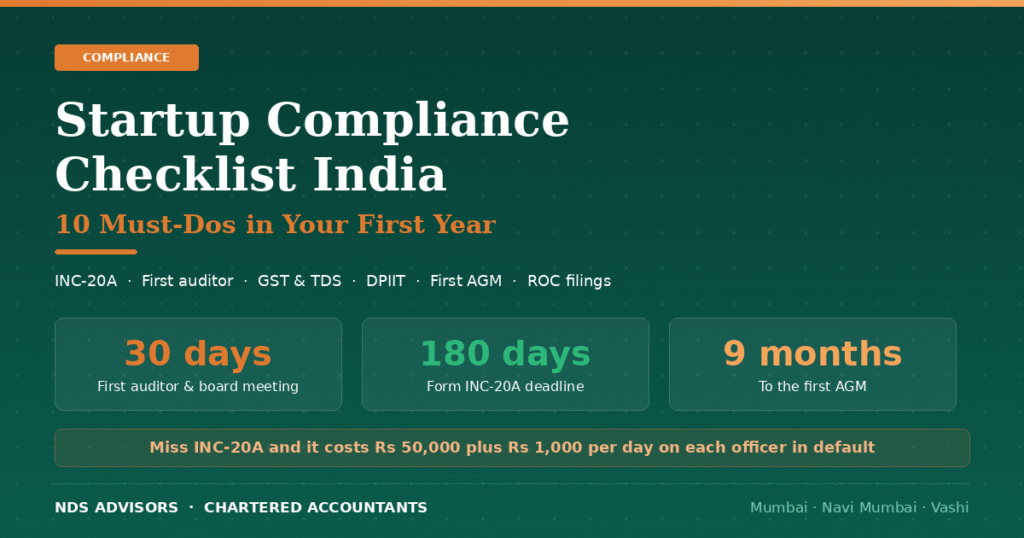
Startup compliance in the first year means completing roughly ten statutory obligations under the Companies Act, 2013 and the tax laws, most of which are triggered by the date of incorporation rather than by revenue. A newly incorporated private limited company must appoint its first auditor within 30 days, hold its first board meeting within the same 30 days, issue share certificates within 60 days, and file the declaration of commencement of business in Form INC-20A within 180 days — whether or not it has earned a single rupee.
That last point is where most first-time founders come unstuck. Company law obligations attach to the entity, not to its trading activity, so a startup with no customers and no bank balance carries almost the same filing calendar as one with revenue. Startup compliance penalties are equally indifferent: ₹50,000 for a missed INC-20A, ₹5,000 for a missed director KYC, and daily accruals on late annual filings. This checklist sets out what falls due, when, and what it costs to get it wrong. Founders who would rather delegate the whole calendar can hand it to our startup services team, but every founder should still understand the shape of it.
- Six of the ten first-year items fall due within six months of incorporation — long before there is a finance team to handle them.
- Form INC-20A is the single most expensive miss: ₹50,000 on the company, ₹1,000 per day on each officer in default up to ₹1,00,000, plus grounds for strike-off.
- Every company must be audited regardless of turnover, profit or activity — a nil-revenue startup still files AOC-4, MGT-7 and an income tax return.
- DPIIT recognition alone does not give the tax holiday. The Section 80-IAC deduction needs a separate Inter-Ministerial Board certificate.
- Angel tax is gone from assessment year 2025-26, but Section 68 on unexplained cash credits still applies, so investor source-of-funds documentation still matters.
What Does Startup Compliance Actually Cover in the First Year?
Startup compliance covers four separate streams that run in parallel: company law filings with the Registrar of Companies, tax registrations and returns, labour and state-level registrations, and the annual audit and accounts cycle. Each stream has its own regulator, its own deadlines and its own penalties.
Founders tend to think of startup compliance as one thing that happens once a year in September. In practice the first-year calendar front-loads heavily. Six of the ten items below fall due within the first six months of incorporation, long before there is a finance team to handle them. The annual cycle, which most people picture when they hear the phrase, is only the tail end.
The entity type also changes the answer. A private limited company carries the heaviest load. An LLP files Form 11 and Form 8 and escapes most of the board and general meeting machinery. A proprietorship has no corporate filings at all, only tax ones. Everything that follows assumes a private limited company, because that is what venture-funded startups almost always are.
Which Startup Compliance Tasks Fall Due in the First 30 Days?
Three: the first board meeting, the appointment of the first statutory auditor, and opening the company bank account so subscribers can pay in their share capital. All three are usually handled in a single sitting.
Section 173(1) of the Companies Act, 2013 requires the first board meeting within 30 days of incorporation. Section 139(6) requires the Board to appoint the first auditor in the same window; if it does not, the members must do so within 90 days at an extraordinary general meeting. The first auditor holds office until the first annual general meeting concludes. Companies that have just completed private limited company registration frequently let this 30-day window pass because the certificate of incorporation feels like the finish line rather than the starting gun.
Getting the bank account open early matters more than it appears. Subscription money must actually be received before Form INC-20A can be filed, and account opening at Indian banks routinely takes three to four weeks for a new company. A delay here cascades into the 180-day deadline.
What Are the 10 Must-Dos on a Startup Compliance Checklist for India?
This startup compliance checklist is ordered by when each item falls due rather than by importance, because in the first year sequence is the whole problem. Work through them in this order and nothing collides.
- Hold the first board meeting and appoint the first auditor. Both within 30 days of incorporation. Record the minutes properly, since the auditor appointment, the bank account resolution and the registered office confirmation typically flow from this meeting. A private limited company must hold at least four board meetings a year, with no more than 120 days between them, though small companies manage with two.
- File Form ADT-1 for the auditor appointment. Filing is unambiguously required for appointments made at the annual general meeting under Section 139(1). For the very first auditor appointed by the Board under Section 139(6) the position is debated, and the safer practice most firms follow is to file anyway. Our ADT-1 auditor appointment team files it as standard rather than leaving the point open.
- Issue share certificates and pay stamp duty. Within two months of incorporation for subscribers to the memorandum, under Section 56(4). Stamp duty is a state subject and is payable on each certificate. Unstamped certificates surface as a diligence finding at the first funding round, usually at the worst possible moment.
- Open the statutory registers. The register of members, register of directors and key managerial personnel, and register of charges must be maintained at the registered office from day one. These are not filings, so nobody chases you for them, which is exactly why they are usually reconstructed in a panic two years later.
- File Form INC-20A within 180 days. The declaration of commencement of business under Section 10A, filed once every subscriber has paid the capital agreed in the memorandum. The company cannot borrow or commence business until it is filed. Our commencement of business service covers the bank proof and the verification that go with it.
- Complete the tax registrations. PAN and TAN arrive with incorporation through SPICe+. GST registration follows where the turnover threshold is crossed or where a mandatory trigger applies, such as inter-state supply or supply through an e-commerce operator. Professional tax registration is required in Maharashtra and several other states as soon as there is a payroll.
- Set up TDS deduction and quarterly returns. From the first salary, rent, professional fee or contractor payment, TDS must be deducted and deposited by the seventh of the following month. Quarterly returns follow in Form 24Q for salaries and Form 26Q for other payments, with Form 16 and Form 16A issued afterwards. This is the single most commonly missed item in a startup’s first year.
- Complete labour and establishment registrations. Shops and Establishment registration is usually required within 30 days of commencing operations, depending on the state. Provident fund registration follows at twenty employees and ESI at ten in most states. Track headcount against these thresholds rather than discovering them after the fact.
- Keep the books from month one. Section 128 requires books of account at the registered office on an accrual basis. Reconstructing a year of transactions from bank statements in month eleven costs more than maintaining them, and it makes the audit slower and the auditor more cautious. Many early-stage companies use outsourced bookkeeping until a hire is justified.
- Close the year: audit, AGM, ROC filings and return. Statutory audit, then the first annual general meeting within nine months of the end of the first financial year, then Form AOC-4 within 30 days of that meeting and the annual return in Form MGT-7 or MGT-7A within 60 days. The income tax return and, separately, DIR-3 KYC for every director by 30 September complete the cycle.
| When It Falls Due | What Has To Happen | Provision |
|---|---|---|
| Within 30 days of incorporation | First board meeting held and minuted | Section 173(1), Companies Act, 2013 |
| Within 30 days of incorporation | First statutory auditor appointed by the Board — failing which, by members within 90 days at an EGM | Section 139(6), Companies Act, 2013 |
| Within 60 days of incorporation | Share certificates issued to subscribers, stamp duty paid | Section 56(4), Companies Act, 2013 |
| From day one | Statutory registers opened; books of account maintained on an accrual basis | Section 128, Companies Act, 2013 |
| Within 180 days of incorporation | Form INC-20A filed after subscription money is received | Section 10A, Companies Act, 2013 |
| By the 7th of the following month | TDS deducted and deposited; quarterly returns in Form 24Q and Form 26Q | Income-tax Act, 1961 |
| 30 June each year | Form DPT-3 — return of deposits and money received that is not a deposit | Companies Act, 2013 |
| 31 October and 30 April | MSME Form 1 where dues to micro or small suppliers are outstanding beyond 45 days | Companies Act, 2013 |
| By 30 September | DIR-3 KYC for every director | Companies Act, 2013 |
| Within 9 months of first FY end | First AGM, then AOC-4 within 30 days and MGT-7 / MGT-7A within 60 days | Sections 96(1), 137 and 92, Companies Act, 2013 |
Deadlines run from the date of incorporation or, for the annual cycle, from the end of the first financial year. Verify each due date against your own certificate of incorporation before relying on it.
Which Tax Registrations Does a Startup Need, and When?
Tax registrations are the second stream of startup compliance, and PAN and TAN come automatically with incorporation. GST registration is required once turnover crosses ₹40 lakh for goods or ₹20 lakh for services, and immediately regardless of turnover where the company makes inter-state supplies or sells through an e-commerce operator.
| Registration | Threshold or Trigger | Ongoing Obligation |
|---|---|---|
| PAN and TAN | Issued automatically with incorporation through SPICe+ | Quote on all filings and TDS deposits |
| GST — goods | Turnover above ₹40 lakh (₹20 lakh in special category states) | Monthly or quarterly returns, including nil months |
| GST — services | Turnover above ₹20 lakh (₹10 lakh in special category states) | Monthly or quarterly returns, including nil months |
| GST — mandatory triggers | Inter-state supply, or supply through an e-commerce operator — regardless of turnover | Registration required from the first such supply |
| TDS | First salary, rent, professional fee or contractor payment | Deposit by the 7th; Form 24Q and 26Q quarterly; Form 16 / 16A issued |
| Professional tax | Payroll in Maharashtra and several other states | Periodic payment and return as the state prescribes |
| Shops and Establishment | Usually within 30 days of commencing operations, depending on the state | Renewal as the state prescribes |
| Provident fund / ESI | Twenty employees for PF; ten for ESI in most states | Monthly contribution and return once registered |
Special category states apply lower thresholds. Many startups register for GST voluntarily well below the threshold, because business customers want an invoice carrying input tax credit and will otherwise negotiate the GST off the price. Voluntary registration is a commercial decision with a compliance cost attached: monthly or quarterly returns begin immediately and continue even in months with nil turnover. Our GST registration team advises on the timing rather than treating it as a default.
TDS deserves separate attention because it starts earlier than founders expect. A company paying ₹50,000 a month in office rent crosses the threshold in its first quarter. Interest at 1% per month runs for late deduction and 1.5% for late deposit, and disallowance of the expense follows where the default persists, which turns a cash flow slip into a tax cost.
What Does DPIIT Recognition Give You, and Is Section 80-IAC Worth It?
DPIIT recognition is free, self-certified and usually granted in under a week, and it lightens the startup compliance load through self-certification under labour and environmental laws, fast-tracked patent examination, public procurement relaxations and access to the Fund of Funds. What it does not do on its own is give you the tax holiday. The deduction under Section 80-IAC requires a separate certificate from the Inter-Ministerial Board.
What the deduction actually gives you
100% of eligible profits for any three consecutive assessment years out of the first ten, available to companies and LLPs incorporated between 1 April 2016 and 31 March 2030 following the extension in the Finance Act 2025, with turnover not exceeding ₹100 crore.
Choose the three years deliberately
Most startups are loss-making early, and claiming the holiday in years with negligible profit wastes it. Minimum alternate tax at 15% of book profit still applies to companies during the holiday years, so the saving is real but not total.
Angel tax is gone — with two caveats
Angel tax under Section 56(2)(viib) was abolished by the Finance Act 2024 with effect from assessment year 2025-26, for every class of investor. Shares can now be issued at a premium above fair market value without that charge arising. Two caveats survive: assessments already open for earlier years remain live, and Section 68 on unexplained cash credits still applies, so investor source-of-funds documentation matters as much as ever.
What Happens at the End of the First Financial Year?
The audit runs first, then the first annual general meeting within nine months from the end of the first financial year, then two filings with the Registrar. Form AOC-4 carries the financial statements and is due within 30 days of the meeting; the annual return in Form MGT-7, or MGT-7A for small companies and one person companies, is due within 60 days. Our annual filings team runs this sequence backwards from the AGM date so the audit is not the bottleneck.
Every company must be audited, regardless of turnover or activity. A startup with nil revenue still needs an audit report, still files AOC-4 and MGT-7, and still files an income tax return. This is separate from tax audit under Section 44AB of the Income-tax Act, 1961, which is triggered only above the prescribed turnover thresholds and applies to far fewer first-year companies than founders assume.
Two startup compliance filings sit outside the AGM cycle and are missed constantly. Form DPT-3, the return of deposits and of money received that is not a deposit, falls due on 30 June. Where the company has outstanding dues to micro or small enterprise suppliers beyond 45 days, MSME Form 1 is filed half-yearly on 31 October and 30 April. Both apply to companies with modest balance sheets, not only to large ones.
What Does Weak Startup Compliance Actually Cost a Founder?
More than the penalty. Late ROC filings attract additional fees that escalate with delay, and prolonged default can lead to disqualification of directors under Section 164(2) and to strike-off proceedings against the company.
- The transactional cost. Every funding round, acquisition and bank facility runs a diligence exercise, and the corporate secretarial file is among the first things opened.
- Delay and lost leverage. Missing minutes, unstamped share certificates, an unfiled INC-20A or a gap in the statutory registers do not usually kill a deal, but they delay it and they shift negotiating leverage. Retrospective rectification is expensive and sometimes impossible.
- Personal exposure. Penalties under the Companies Act, 2013 frequently attach to officers in default personally, not only to the company.
- Five-year disqualification. A disqualified director cannot be appointed to any company for five years. Treating startup compliance as an administrative chore misprices a personal risk.
How Has India’s Startup Regulatory Framework Changed Since Before 1991?
Before 1991 there was no meaningful path for a small new company at all. Industrial licensing determined who could manufacture what and at what scale, the Monopolies and Restrictive Trade Practices Act, 1969 constrained expansion by larger houses, and the Foreign Exchange Regulation Act, 1973 made foreign capital difficult to accept. A founder with an idea and no licence had few options, and the Companies Act, 1956 assumed established enterprises rather than new ventures.
Liberalisation dismantled the licensing regime and reopened the door to foreign investment, with the Foreign Exchange Management Act, 1999 replacing the earlier prohibitionist framework. The structural change most relevant here came later. The Companies Act, 2013 rebuilt corporate law around governance and disclosure, introduced the one person company and eventually the small company concessions that reduce the load on early-stage businesses. Registry filings moved online and are now administered through the Ministry of Corporate Affairs portal at mca.gov.in.
Three developments since 2016 shaped the current position. Startup India launched that year and created DPIIT recognition along with the Section 80-IAC tax holiday. The Goods and Services Tax Act, 2017 replaced a fragmented indirect tax system with a single registration and a digital invoice trail. Incorporation itself was consolidated into the SPICe+ form in 2020, so that name reservation, incorporation, PAN, TAN, EPFO, ESIC, professional tax and the bank account are applied for together.
The most recent changes have run in the startup’s favour. Angel tax is gone from assessment year 2025-26, and the Section 80-IAC incorporation window now extends to 31 March 2030. The Income-tax Act, 2025 takes effect from 1 April 2026 and carries the startup provisions forward under renumbered sections, so the substance of first-year startup compliance is unchanged even though the section references in older articles will not match the new statute.
Why Early-Stage Companies Work with NDS Advisors
- The calendar is set at the outset: we map every first-year due date from your certificate of incorporation, so nothing is discovered in month eleven.
- Incorporation formalities handled properly: the first board meeting and the auditor appointment, minuted and filed rather than left as an open point.
- INC-20A filed on time: including the bank proof and verification that go with the declaration of commencement of business.
- Statutory registers kept in order: members, directors and KMP, and charges — maintained from day one, not reconstructed under diligence pressure.
- Audit and ROC cycle run end to end: planned backwards from the AGM date so the file stands up when an investor opens it.
Frequently Asked Questions
What is the first compliance a newly incorporated private limited company must complete?
What is INC-20A and what happens if I miss the 180-day deadline?
When is the first AGM of a newly incorporated company due?
Does a startup need a statutory audit even if it has no revenue?
Is DPIIT recognition enough to claim the Section 80-IAC tax holiday?
Is angel tax still applicable to startup fundraising?
The bottom line
The first-year startup compliance calendar is front-loaded and runs from the date of incorporation, not from first revenue. Get the 30-day items, the 60-day share certificates and the 180-day INC-20A right, keep the registers and books from day one, and the annual cycle becomes routine. The expensive mistake is not a wrong filing — it is discovering in month eleven what was due in month one.
Suite No. 102, L1, Ashok Premises, Nicholas Road, Andheri (East), Mumbai 400069 · Mon–Sat, 10:00 AM – 7:00 PM
Written by the team at NDS Advisors, Chartered Accountants
Andheri (East), Mumbai · Navi Mumbai · Vashi · pan-India
Audit and assurance, income tax and GST, company incorporation, ROC and MCA compliance, accounting outsourcing and corporate advisory. Every article published on ndsadvisors.com is reviewed against the current provisions of Indian corporate and tax law before publication.