
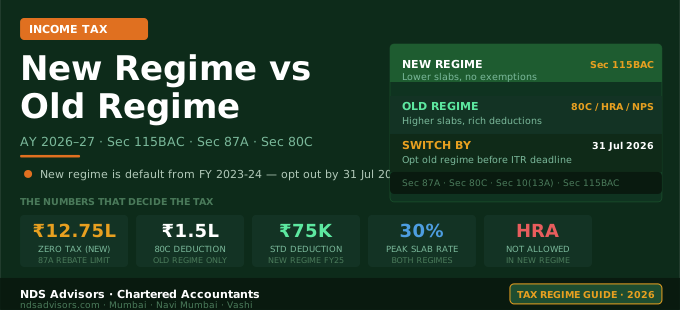
The new tax regime saves more tax for most salaried individuals earning up to ₹12,75,000 per year — they pay zero tax under the new regime thanks to the ₹75,000 standard deduction and the Section 87A rebate for taxable income up to ₹12 lakh. Above that, the two regimes trade the advantage back and forth depending on how much the taxpayer can claim in deductions and exemptions, and the crossover point moves as income rises.
The new tax regime saves more tax for most salaried individuals earning up to ₹12,75,000 per year — they pay zero tax under the new regime thanks to the ₹75,000 standard deduction and the Section 87A rebate for taxable income up to ₹12 lakh. For individuals earning ₹15 lakh to ₹30 lakh, the answer depends on one number: total deductions. If your deductions under the old regime — Section 80C, 80D, 80CCD(1B), HRA exemption, home loan interest under Section 24(b), and other eligible deductions — exceed approximately ₹3.75 lakh to ₹4.25 lakh, the old regime typically produces lower tax despite its higher slab rates. Below that deduction threshold, the new regime's lower rates win. This is the essential framework for the new regime vs old regime comparison for AY 2026–27, and this guide provides the exact slab rates, worked examples at four income levels (₹10 lakh, ₹15 lakh, ₹20 lakh, and ₹30 lakh), and a step-by-step decision process so you can determine which regime saves you more tax. NDS Advisors provides tax advisory services that include personalised old vs new regime analysis for individuals and businesses across India.
- The new regime is the default from AY 2024-25. Taxpayers must actively elect the old regime if they want it, rather than the other way around.
- Zero tax up to roughly ₹12.75 lakh under the new regime. The ₹75,000 standard deduction plus the full Section 87A rebate up to ₹12,00,000 taxable income combine to erase tax entirely for most salaried earners in that band.
- The break-even deduction level rises with income. Roughly ₹3.75–₹4.25 lakh of deductions at ₹15 lakh income, widening to ₹6.5–₹8 lakh at ₹30 lakh income.
- The old regime’s advantage is concentrated in a handful of deductions. Home loan interest, HRA, 80C, 80D and 80CCD(1B) are what move the needle; everything else is marginal.
- The choice can be revisited every year for salaried taxpayers. Those with business or professional income face restrictions on switching back once they opt out of the new regime.
What Are the Exact Slab Rates Under the New and Old Tax Regime for AY 2026–27?
| Income Slab | Rate |
|---|---|
| Up to ₹4,00,000 | Nil |
| ₹4,00,001 to ₹8,00,000 | 5% |
| ₹8,00,001 to ₹12,00,000 | 10% |
| ₹12,00,001 to ₹16,00,000 | 15% |
| ₹16,00,001 to ₹20,00,000 | 20% |
| ₹20,00,001 to ₹24,00,000 | 25% |
| Above ₹24,00,000 | 30% |
| Standard deduction | ₹75,000 |
| Section 87A rebate | Full, up to ₹12,00,000 |
Most Chapter VI-A deductions (80C, 80D, 80E, 80G, 80TTA) and exemptions (HRA, LTA) are not available under the new regime.
| Income Slab | Rate |
|---|---|
| Up to ₹2,50,000 | Nil |
| ₹2,50,001 to ₹5,00,000 | 5% |
| ₹5,00,001 to ₹10,00,000 | 20% |
| Above ₹10,00,000 | 30% |
| Standard deduction | ₹50,000 |
| Section 87A rebate | Full, up to ₹5,00,000 |
All deductions remain available under the old regime — 80C (₹1.5L), 80D, 80CCD(1B) (₹50K), HRA, LTA, Section 24(b) home loan interest (₹2L), 80G, 80E, 80TTA. A 4% health and education cess applies to tax under both regimes.
How Does the Tax Compare at ₹10 Lakh, ₹15 Lakh, ₹20 Lakh, and ₹30 Lakh Income?
The following four worked examples compare the actual tax payable under both regimes for a salaried employee at different income levels, assuming typical deduction scenarios. All examples include 4% cess.
| Gross Salary | New Regime Tax | Old Regime Tax | Winner |
|---|---|---|---|
| ₹10,00,000 | ₹0 | ₹54,600 (₹2.5L deductions) | New, by ₹54,600 |
| ₹15,00,000 | ₹97,500 | ₹1,06,600 (₹5L deductions) | New, by ₹9,100 |
| ₹20,00,000 | ₹1,92,400 | ₹1,95,000 (₹7L deductions) | Nearly equal |
| ₹30,00,000 | ₹4,75,800 | ₹4,75,800 (₹8L deductions) | Exactly equal |
Old regime figures shown are at the deduction level closest to break-even for that income; lower deduction levels favour the new regime by a wider margin. Illustrative figures only — verify against your own numbers.
Example 1 — Gross Salary ₹10,00,000:
New Regime: Gross salary ₹10,00,000 minus standard deduction ₹75,000 = taxable income ₹9,25,000. Tax: ₹4,00,000 × 0% + ₹4,00,000 × 5% + ₹1,25,000 × 10% = ₹20,000 + ₹12,500 = ₹32,500. But taxable income is below ₹12,00,000, so Section 87A rebate applies — tax = nil. Total tax (new regime) = ₹0. Old Regime (with ₹2.5 lakh deductions — ₹1.5L 80C, ₹25K 80D, ₹50K 80CCD(1B), ₹25K 80TTA): Gross salary ₹10,00,000 minus standard deduction ₹50,000 minus deductions ₹2,50,000 = taxable income ₹7,00,000. Tax: ₹2,50,000 × 0% + ₹2,50,000 × 5% + ₹2,00,000 × 20% = ₹12,500 + ₹40,000 = ₹52,500 + cess ₹2,100 = ₹54,600. Winner: New regime saves ₹54,600.
Example 2 — Gross Salary ₹15,00,000:
New Regime: ₹15,00,000 minus ₹75,000 = ₹14,25,000. Tax: ₹4L × 0% + ₹4L × 5% + ₹4L × 10% + ₹2,25,000 × 15% = ₹20,000 + ₹40,000 + ₹33,750 = ₹93,750 + cess ₹3,750 = ₹97,500. Old Regime (₹3.5 lakh deductions — ₹1.5L 80C, ₹50K 80CCD(1B), ₹25K 80D, ₹1.25L HRA): ₹15,00,000 minus ₹50,000 minus ₹3,50,000 = ₹11,00,000. Tax: ₹2.5L × 0% + ₹2.5L × 5% + ₹5L × 20% + ₹1L × 30% = ₹12,500 + ₹1,00,000 + ₹30,000 = ₹1,42,500 + cess ₹5,700 = ₹1,48,200. Winner: New regime saves ₹50,700. Old Regime (₹5 lakh deductions — add ₹1.5L home loan interest): taxable income = ₹9,50,000. Tax = ₹12,500 + ₹90,000 = ₹1,02,500 + cess = ₹1,06,600. Here new regime (₹97,500) still wins by ₹9,100 — but the gap has narrowed significantly.
Example 3 — Gross Salary ₹20,00,000:
New Regime: ₹20,00,000 minus ₹75,000 = ₹19,25,000. Tax: ₹4L × 0% + ₹4L × 5% + ₹4L × 10% + ₹4L × 15% + ₹3,25,000 × 20% = ₹20,000 + ₹40,000 + ₹60,000 + ₹65,000 = ₹1,85,000 + cess ₹7,400 = ₹1,92,400. Old Regime (₹5 lakh deductions): taxable income = ₹14,50,000. Tax = ₹12,500 + ₹1,00,000 + ₹1,35,000 = ₹2,47,500 + cess = ₹2,57,400. New regime saves ₹65,000. Old Regime (₹7 lakh deductions — adding ₹2L home loan interest): taxable income = ₹12,50,000. Tax = ₹12,500 + ₹1,00,000 + ₹75,000 = ₹1,87,500 + cess = ₹1,95,000. Now old regime (₹1,95,000) and new regime (₹1,92,400) are nearly identical — the break-even is approximately ₹6.75 lakh deductions at ₹20 lakh income.
Example 4 — Gross Salary ₹30,00,000:
New Regime: ₹30,00,000 minus ₹75,000 = ₹29,25,000. Tax: ₹4L × 0% + ₹4L × 5% + ₹4L × 10% + ₹4L × 15% + ₹4L × 20% + ₹4L × 25% + ₹5,25,000 × 30% = ₹20,000 + ₹40,000 + ₹60,000 + ₹80,000 + ₹1,00,000 + ₹1,57,500 = ₹4,57,500 + cess ₹18,300 = ₹4,75,800. Old Regime (₹5 lakh deductions): taxable income = ₹24,50,000. Tax = ₹12,500 + ₹1,00,000 + ₹4,35,000 = ₹5,47,500 + cess = ₹5,69,400. New regime saves ₹93,600. Old Regime (₹8 lakh deductions): taxable income = ₹21,50,000. Tax = ₹12,500 + ₹1,00,000 + ₹3,45,000 = ₹4,57,500 + cess = ₹4,75,800. Exactly equal. At ₹30 lakh income, the break-even deduction level is approximately ₹8 lakh — achievable only for homeowners with maximum home loan interest plus full 80C, 80D, 80CCD(1B), and substantial HRA. Professional tax planning computes this comparison with your exact figures.
Which Deductions Are Available Under Each Regime and How Do They Affect the Decision?
The deductions available under the old regime — and denied under the new regime — are the entire basis of the regime comparison. If you have no deductions beyond the standard deduction, the new regime always wins because its slab rates are lower at every income level. The old regime wins only when deductions reduce taxable income enough to overcome the rate disadvantage.
Deductions Available Under Both Regimes
Standard deduction (₹75,000 new, ₹50,000 old). Employer NPS contribution under Section 80CCD(2) — up to 10% of salary (14% for central government employees). Family pension deduction under Section 57(iia) — up to ₹25,000. Transport allowance for differently-abled. Conveyance allowance for official duties.
Deductions Available Only Under the Old Regime
Section 80C — PPF, ELSS, LIC, NSC, tuition fees, home loan principal — up to ₹1,50,000. Section 80CCD(1B) — additional NPS contribution — up to ₹50,000. Section 80D — health insurance premiums — ₹25,000 self/family, ₹25,000/₹50,000 parents. Section 24(b) — home loan interest — up to ₹2,00,000 for self-occupied property. Section 10(13A) — HRA exemption (varies by rent paid and salary). Section 10(5) — LTA exemption. Section 80TTA — savings bank interest — up to ₹10,000 (₹50,000 for seniors under 80TTB). Section 80E — education loan interest (no limit). Section 80G — donations. Section 80U — disability deduction.
The ₹25,000 Standard Deduction Differential
The new regime provides a ₹75,000 standard deduction while the old regime provides ₹50,000 — a ₹25,000 advantage for the new regime. This means your old regime deductions must exceed the new regime's advantage by this ₹25,000 plus the benefit of lower slab rates. For most taxpayers, the effective deduction threshold where the old regime starts winning is approximately ₹3.75 lakh to ₹4.25 lakh for income of ₹15 lakh, rising to ₹6.50 lakh to ₹8 lakh at ₹30 lakh income. Companies that provide payroll advisory help employees model these comparisons during the investment declaration process at the start of the financial year.
How Has the Tax Regime Landscape Evolved from 2020 to AY 2026–27?
The new vs old regime debate is only six years old but has already gone through three significant iterations, each making the new regime more attractive.
Budget 2020 — The New Regime Is Introduced (AY 2021–22)
Finance Minister Nirmala Sitharaman introduced the new tax regime under Section 115BAC in the Union Budget 2020. The original slab rates were: nil up to ₹2.5L, 5% (₹2.5–5L), 10% (₹5–7.5L), 15% (₹7.5–10L), 20% (₹10–12.5L), 25% (₹12.5–15L), 30% (above ₹15L). The regime was optional — the old regime remained the default. The initial uptake was low because the slab rates were only marginally better than the old regime for most taxpayers, and the loss of all deductions made it unattractive for anyone with investments or a home loan. The government's intent was clear: gradually make the new regime more attractive to shift taxpayers toward a deduction-free, lower-rate framework, as stated in the Income Tax Department's communications.
Budget 2023 — The New Regime Becomes Default (AY 2024–25)
Budget 2023 made the new regime the default — it applies automatically unless the taxpayer opts out. The slab rates were revised downward: nil up to ₹3L, 5% (₹3–6L), 10% (₹6–9L), 15% (₹9–12L), 20% (₹12–15L), 30% (above ₹15L). The standard deduction of ₹50,000 was extended to the new regime (it was previously old-regime only). The Section 87A rebate threshold was increased to ₹7 lakh. These changes made the new regime significantly more attractive, and the number of taxpayers choosing the new regime increased substantially.
Budget 2025 — Further Sweetening for AY 2026–27
Budget 2025 further revised the new regime: nil up to ₹4L, 5% (₹4–8L), 10% (₹8–12L), 15% (₹12–16L), 20% (₹16–20L), 25% (₹20–24L), 30% (above ₹24L). The standard deduction was increased to ₹75,000. The Section 87A rebate threshold was increased to ₹12 lakh, meaning zero tax for salaried income up to approximately ₹12,75,000. Each iteration has widened the gap between the two regimes for taxpayers with low to moderate deductions, while the old regime remains competitive only for taxpayers with very high deductions — primarily homeowners with significant home loan interest.
Which Regime Is Better for Specific Taxpayer Profiles?
The new regime vs old regime answer changes depending on the taxpayer's specific financial profile. The following scenarios cover the most common salaried employee situations.
Salaried Employee With No Investments or Home Loan
New regime is always better. Without any deductions beyond the standard deduction, the new regime's lower slab rates produce lower tax at every income level. There is no scenario where the old regime wins for a taxpayer with zero deductions beyond standard deduction.
Salaried Employee Maximising 80C and 80D Only (₹2 Lakh Deductions)
New regime is better at all income levels. ₹2 lakh in deductions is not enough to overcome the new regime's lower slab rates and higher standard deduction. These taxpayers should switch to the new regime without hesitation.
Salaried Employee With Home Loan (₹4–₹5 Lakh Total Deductions)
This is the grey zone. At ₹15 lakh income, the new regime is marginally better. At ₹20 lakh income, the two regimes are roughly equal. At ₹25 lakh and above, the old regime starts winning. The exact crossover depends on the mix of deductions — particularly how much of the deduction comes from Section 24(b) home loan interest, which is one of the largest single deductions available.
Salaried Employee With High HRA, Home Loan, and Full Deductions (₹6+ Lakh)
Old regime is better for income above ₹15 lakh. A salaried employee in Mumbai or Delhi paying ₹40,000+ per month in rent, with a home loan on a second property, and maximising 80C, 80D, 80CCD(1B), and 80TTA can easily accumulate ₹6 lakh to ₹8 lakh in total deductions. At these deduction levels, the old regime produces significantly lower tax for income above ₹15 lakh. However, this profile represents a minority of salaried taxpayers. Professional tax advisory models the exact comparison for each client's specific situation.
Senior Citizens (60+ Years)
Senior citizens benefit from higher deduction limits under the old regime — ₹50,000 under 80TTB (vs ₹10,000 under 80TTA for non-seniors), higher health insurance limits under 80D (₹50,000 vs ₹25,000), and a higher basic exemption limit of ₹3,00,000 under the old regime (vs ₹4,00,000 under the new regime for all age groups). For senior citizens with significant interest income and health insurance costs, the old regime typically remains more beneficial. Seniors should evaluate both regimes carefully with professional support.
What Is the Step-by-Step Process to Decide Between the New and Old Regime?
Follow this six-step process to determine which regime saves you more tax for AY 2026–27.
- List Your Gross Total Income from All Sources. Start with your gross salary (from Form 16 Part B), add income from house property (rental income or home loan interest loss), income from other sources (bank interest, FD interest, dividends), and capital gains (if any). This is your gross total income before any deductions.
- Compute Tax Under the New Regime. From your gross total income, deduct only the new regime standard deduction (₹75,000 for salaried) and employer NPS (80CCD(2)) if applicable. Apply the new regime slab rates: nil up to ₹4L, 5% (₹4–8L), 10% (₹8–12L), 15% (₹12–16L), 20% (₹16–20L), 25% (₹20–24L), 30% (above ₹24L). Check if Section 87A rebate applies (taxable income ≤ ₹12L). Add 4% cess. This is your total tax under the new regime.
- List Every Deduction and Exemption Available Under the Old Regime. Add up all deductions you can legitimately claim: old regime standard deduction (₹50,000), Section 80C (up to ₹1.5L), Section 80CCD(1B) (up to ₹50K NPS), Section 80D (₹25K–₹1L health insurance), Section 24(b) (up to ₹2L home loan interest), HRA exemption (compute based on rent, salary, and city), LTA, 80TTA/80TTB, 80G, 80E, and any other applicable deductions. This is your total old regime deduction amount.
- Compute Tax Under the Old Regime. From your gross total income, deduct the total old regime deductions computed in Step 3. Apply the old regime slab rates: nil up to ₹2.5L, 5% (₹2.5–5L), 20% (₹5–10L), 30% (above ₹10L). Check if Section 87A rebate applies (taxable income ≤ ₹5L, max rebate ₹12,500). Add 4% cess. This is your total tax under the old regime.
- Compare the Two Tax Figures and Choose the Lower One. The regime with the lower tax figure saves you more money — choose that regime when filing your ITR. If the difference is small (less than ₹5,000), consider choosing the new regime for simplicity — fewer documentation requirements, fewer claims to justify if the return is selected for scrutiny. Companies providing CFO services run this comparison for senior management and board members as part of year-end tax planning.
- Make the Selection in Your ITR and File Before 31 July 2026. Select the chosen regime in the ITR form on the e-filing portal. Remember: the new regime is the default. If you want the old regime, you must explicitly opt out. File the return before 31 July 2026 to avoid late filing fees (₹5,000 under Section 234F) and interest on unpaid tax (1% per month under Section 234A). Verify the return within 30 days of filing through Aadhaar OTP or another prescribed method. Companies that need regime planning across their workforce benefit from regulatory compliance services that coordinate payroll TDS with the chosen regime.
Frequently Asked Questions About New vs Old Tax Regime
Which tax regime is better for AY 2026–27 — old or new?
What is the Section 87A rebate under the new regime for AY 2026–27?
Can I switch between old and new regime every year?
What deductions are allowed under the new tax regime?
What are the new regime slab rates for AY 2026–27?
The bottom line
Below roughly ₹3.75–4.25 lakh of deductions, the new regime wins outright. Above that, and rising with income, the old regime catches up and can overtake it — particularly for homeowners with home loan interest, high HRA, and full 80C, 80D and 80CCD(1B) claims. There is no fixed answer; there is only your own numbers run through both regimes side by side.
Written by the team at NDS Advisors
NDS Advisors is a professional advisory firm providing tax advisory, tax planning, audit, regulatory compliance, and CFO services across India. Visit ndsadvisors.com to learn more.
Every article published on ndsadvisors.com is reviewed against the current provisions of Indian income tax law before publication.