
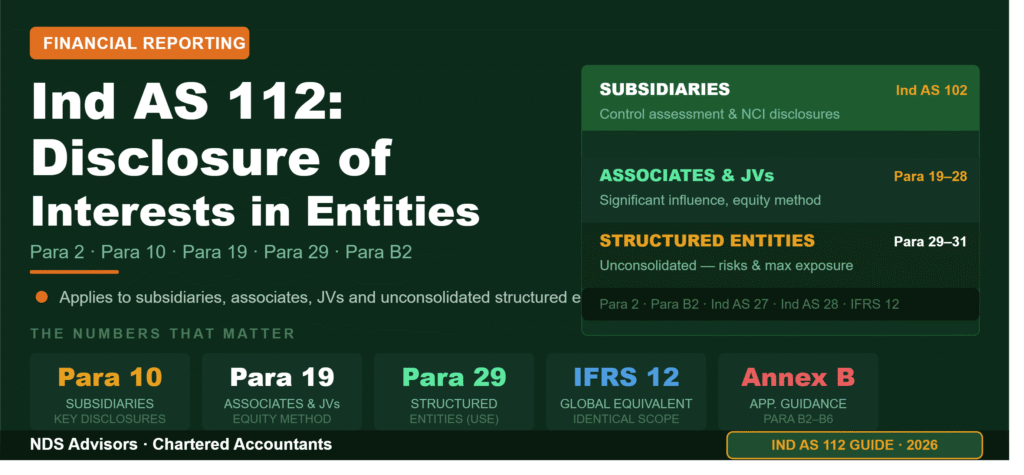
Ind AS 112 is the standard that NFRA cites most frequently when identifying disclosure failures in Indian corporate group financial statements. In audit quality review after audit quality review, the National Financial Reporting Authority has found that companies provide generic, boilerplate disclosures about their subsidiaries, joint ventures, associates, and structured entities — disclosures that name entities and percentages but fail to explain the significant judgements behind control determinations, omit summarised financial information for material subsidiaries with non-controlling interests, and ignore unconsolidated structured entity exposures entirely. It prescribes no recognition and no measurement of its own; it collects the disclosure obligations that follow from decisions made under Ind AS 110, Ind AS 111 and Ind AS 28.
Ind AS 112 is the standard that NFRA cites most frequently when identifying disclosure failures in Indian corporate group financial statements. In audit quality review after audit quality review, the National Financial Reporting Authority has found that companies provide generic, boilerplate disclosures about their subsidiaries, joint ventures, associates, and structured entities — disclosures that name entities and percentages but fail to explain the significant judgements behind control determinations, omit summarised financial information for material subsidiaries with non-controlling interests, and ignore unconsolidated structured entity exposures entirely. These are not trivial omissions. Ind AS 112 (Disclosure of Interests in Other Entities) requires entity-specific, quantitative disclosures that enable investors, lenders, and regulators to evaluate the actual risks embedded in a corporate group structure — the restrictions on moving cash between entities, the extent of non-controlling interests, the off-balance-sheet exposures through structured vehicles, and the judgements management has made about who controls what. For Indian business groups operating through layered holding structures, cross-holdings, and special purpose vehicles, getting Ind AS 112 right is a regulatory, audit, and investor-relations imperative. NDS Advisor provides financial reporting services that include comprehensive Ind AS 112 disclosure preparation, significant judgement documentation, and NFRA-ready consolidation review.
- Subsidiaries get the fullest disclosure. Group composition, material non-controlling interests with summarised financials, restrictions on assets and cash, and changes in ownership without loss of control.
- Joint ventures and associates need summarised financial information when material. Immaterial ones can be aggregated, but the aggregate still needs carrying amount, profit or loss and comprehensive income.
- Unconsolidated structured entities are the most underreported category. Securitisation trusts, ARCs, infrastructure SPVs and AIFs all qualify, and many Indian companies never identify them as in scope at all.
- Significant judgements come first, not last. Control conclusions, joint arrangement classification and investment entity status must each be explained, entity by entity.
- Consolidation and disclosure are separate obligations. A group can consolidate correctly and still fail Ind AS 112 — the two are tested independently.
What Must Companies Disclose About Their Subsidiaries Under Ind AS 112?
Subsidiary disclosures are the most extensive component of Ind AS 112 because the consolidation of subsidiaries creates the highest complexity and the greatest risk of information loss for users of financial statements. The standard requires disclosures across four dimensions for every subsidiary in the group.
Group Composition and Ownership Structure
The entity must disclose the name of each subsidiary, its principal place of business and country of incorporation (if different), the proportion of ownership interest held by the parent, and the proportion of voting rights held (if different from ownership). This information maps the group structure for users. For Indian promoter-led groups with multi-layered holding structures — a holding company owning an intermediate holding company that owns operating subsidiaries — the full ownership chain must be visible. Where control exists without majority ownership (de facto control through contractual arrangements, board nomination rights, or economic dependence), the basis for the control conclusion must be disclosed under the significant judgements requirement.
Material Subsidiaries with Non-Controlling Interests — Detailed Quantitative Disclosures
For each subsidiary where non-controlling interests are material to the reporting entity, Ind AS 112 demands a full set of quantitative data: the NCI's proportion of ownership and voting rights, profit or loss allocated to NCI during the period, accumulated NCI at the end of the period, and dividends paid to NCI. Beyond these headline numbers, the standard requires summarised financial information for each material NCI subsidiary — current assets, non-current assets, current liabilities, non-current liabilities, revenue, profit or loss, other comprehensive income, total comprehensive income, and cash flows from operating, investing, and financing activities. This summarised information must be presented before inter-company eliminations — showing the subsidiary's standalone performance, not the consolidated view. The entity must also provide a reconciliation from the summarised financial information to the NCI carrying amount in the consolidated balance sheet. Companies undergoing due diligence rely on these disclosures to evaluate the standalone performance and minority rights of each significant subsidiary.
Restrictions on Assets and Cash Transfers
Ind AS 112 requires disclosure of any significant restrictions on the parent's ability to access or use the assets of subsidiaries, or to settle their liabilities. These restrictions include regulatory capital requirements (common for banking and insurance subsidiaries), statutory reserves that cannot be distributed as dividends, foreign exchange controls that limit the repatriation of funds from overseas subsidiaries, and contractual restrictions imposed by lenders (debt covenants that restrict dividend payments or asset transfers). For investors evaluating whether a group's consolidated cash is actually available to the parent, these restriction disclosures are among the most valuable in the entire financial statements.
Changes in Ownership Without Loss of Control
When a parent entity changes its ownership interest in a subsidiary without losing control — for example, selling a 10% stake to a financial investor while retaining 60% — Ind AS 112 requires disclosure of the schedule showing the effects of such changes on the equity attributable to owners of the parent. This includes the carrying amount of the NCI before and after the transaction, the consideration received or paid, and any adjustment recognised in equity. These disclosures are particularly relevant for Indian groups that frequently restructure their shareholding through partial divestments, preferential allotments, and intra-group transfers.
What Must Companies Disclose About Joint Ventures and Associates Under Ind AS 112?
Joint ventures and associates — accounted for under the equity method in consolidated financial statements — require their own distinct set of Ind AS 112 disclosures. The disclosures serve a different purpose than subsidiary disclosures: since the investor does not consolidate these entities line by line, the summarised financial information provides users with visibility into the investee's standalone financial position and performance that the single equity-method line item does not reveal.
Basic Information for Every Joint Venture and Associate
For each joint venture and associate, the entity must disclose: the name, principal place of business, country of incorporation, proportion of ownership interest and voting rights (if different), and the measurement method used (equity method). If the entity holds any joint ventures or associates that are individually immaterial, the disclosures may be presented in aggregate, but the aggregate must still include the carrying amount, profit or loss, other comprehensive income, and total comprehensive income.
Summarised Financial Information for Material Joint Ventures and Associates
For each joint venture or associate that is material to the reporting entity, the summarised financial information must include: current assets, non-current assets, current liabilities (including short-term financial liabilities other than trade payables and provisions), non-current liabilities (including long-term financial liabilities), revenue, profit or loss from continuing operations, post-tax profit or loss from discontinued operations, other comprehensive income, and total comprehensive income. The entity must also disclose depreciation and amortisation, interest income, interest expense, and income tax expense for each material equity-accounted investee. A reconciliation from the summarised financial information to the equity-method carrying amount must be provided. Companies with complex investment portfolios require professional Ind AS advisory to ensure that summarised financial information is correctly extracted from the investee's financial statements and reconciled to the equity-method carrying amount in the consolidated balance sheet.
Significant Judgements — Joint Operation vs Joint Venture Classification
One of the most important Ind AS 112 disclosures for joint arrangements is the significant judgement involved in classifying an arrangement as a joint operation (where the entity recognises its share of assets, liabilities, revenues, and expenses directly) or a joint venture (where it uses the equity method). The classification depends on the legal structure of the arrangement, the contractual terms, and any other relevant facts and circumstances. An Indian company participating in a joint arrangement for a highway construction project must evaluate whether the arrangement is structured so that the parties have rights to specific assets and obligations for specific liabilities (joint operation) or rights to the net assets (joint venture). The disclosure must explain the basis for this classification, because the choice fundamentally changes how the arrangement appears in the financial statements.
What Must Companies Disclose About Unconsolidated Structured Entities?
Unconsolidated structured entity disclosures are the most underreported component of Ind AS 112 in Indian financial statements — and the most valuable for assessing off-balance-sheet risk. A structured entity is one designed so that voting or similar rights are not the dominant factor in determining control; instead, control is achieved through contractual arrangements, subordinated financial interests, or other mechanisms.
Common Structured Entities in the Indian Context
Indian companies encounter structured entities in several forms: securitisation trusts that purchase receivables from NBFCs and banks, asset reconstruction companies (ARCs) that acquire distressed assets, infrastructure special purpose vehicles (SPVs) created under concession agreements for roads, airports, and power projects, real estate development SPVs created for specific projects, and investment funds or alternative investment funds (AIFs) sponsored or managed by the entity. When the reporting entity has an interest in such a structured entity but does not consolidate it — because it does not have control under Ind AS 110 — the structured entity is unconsolidated, and Ind AS 112 requires specific disclosures about the nature of the entity's involvement and its risk exposure.
Required Disclosures for Each Unconsolidated Structured Entity
The entity must disclose: the nature and purpose of the structured entity, the nature of its involvement (investment, credit enhancement, liquidity support, guarantee, management services), the carrying amount of the assets in its financial statements that relate to the structured entity, the maximum exposure to loss from its involvement (and how that maximum exposure is determined), and any financial or other support provided during the period — including support not previously contractually required, with the reasons for providing it. If the entity has provided any implicit or explicit guarantee to the structured entity, the terms and potential exposure must be disclosed.
For Indian banks and NBFCs, structured entity disclosures are particularly critical because securitisation transactions, co-lending arrangements, and ARC investments create off-balance-sheet exposures that can be material. The Reserve Bank of India has issued specific guidance on securitisation disclosures that supplements Ind AS 112 requirements. Companies engaged in corporate restructuring that involves creating or unwinding structured entities must ensure that Ind AS 112 disclosures are updated to reflect the current exposure profile throughout the restructuring process.
How Has Group Disclosure Transparency Evolved for Indian Corporate Groups?
The quality and depth of group structure disclosures in India have transformed fundamentally over three decades — and the change can be measured by what investors could see at each stage.
Pre-2001 — Investors Could See Almost Nothing
Before mandatory consolidated financial statements under AS 21, Indian investors evaluated holding companies based on standalone financial statements alone. A parent company's balance sheet showed investments in subsidiaries at cost — a single line item that revealed nothing about the subsidiary's assets, liabilities, performance, or the restrictions on transferring cash back to the parent. Investors could not assess the true financial position of the group. The ICAI issued AS 21 to address this gap, but the accompanying disclosure requirements were minimal.
2001–2016 — Investors Could See the Consolidated Numbers But Not the Risk
The adoption of AS 21 (Consolidated Financial Statements), AS 23 (Investments in Associates), and AS 27 (Joint Ventures) introduced consolidated reporting for listed companies. Investors could now see the group's total assets, liabilities, and profits. However, the disclosures about individual entities within the group remained superficial — a list of subsidiaries and associates with ownership percentages, but no summarised financial information, no NCI detail, no restriction disclosures, and no structured entity information. An investor looking at a Nifty 50 company's consolidated financial statements could see that the group had ₹10,000 crore in assets but could not determine how much of that was in subsidiaries with significant NCI, how much was subject to regulatory restrictions, or what off-balance-sheet exposure existed through SPVs. The information asymmetry between management and investors was substantial.
2016 to Present — Ind AS 112 Gives Investors the Full Picture
Ind AS 112, notified by the Ministry of Corporate Affairs through the Companies (Indian Accounting Standards) Rules, 2015, addressed every gap in the previous framework. For the first time, investors could see summarised financial information for material subsidiaries with NCI, understand the significant judgements behind control and influence determinations, identify restrictions on intra-group cash transfers, and assess off-balance-sheet structured entity exposure. The establishment of the NFRA in 2018 added enforcement — audit quality reviews now specifically evaluate whether Ind AS 112 disclosures are substantive or boilerplate, and NFRA orders have cited inadequate disclosures as audit failures. The result is that investors in Indian listed companies today have access to group structure information that is comparable to what investors in IFRS-adopting countries worldwide receive under IFRS 12.
What Is the Step-by-Step Process to Draft Compliant Ind AS 112 Disclosure Notes?
Drafting Ind AS 112 disclosures is a data-intensive exercise that requires coordination between the parent's consolidation team, the finance teams of each subsidiary, joint venture, and associate, and the statutory auditor. The following steps ensure completeness and NFRA readiness.
- Build a Master Entity Register with Classification and Materiality Assessment. Create a register listing every entity in which the reporting entity has an interest — direct and indirect subsidiaries (including step-down subsidiaries), joint operations, joint ventures, associates, and unconsolidated structured entities. For each entity, record the name, CIN or registration number, country of incorporation, principal place of business, ownership percentage, voting rights percentage (if different), the Ind AS standard governing the accounting treatment (Ind AS 110 for subsidiaries, Ind AS 111 for joint arrangements, Ind AS 128 for associates), and whether the entity is material for detailed disclosure purposes. This register is the foundation for every subsequent step.
- Draft the Significant Judgements Section First. Begin the disclosure note with the significant judgements — not the entity list. Ind AS 112 requires disclosure of the judgements and assumptions made in determining control, joint control, significant influence, and the classification of joint arrangements. For each entity where the determination required judgement (not mechanically obvious from majority ownership), prepare a narrative explaining: what indicators were evaluated, what conclusion was reached, and why. Common scenarios requiring judgement in India include: holding less than 50% but asserting control through a shareholders' agreement, holding exactly 20% but arguing absence of significant influence because of a passive investment stance, and classifying a joint arrangement as an operation rather than a venture based on the contractual terms of a concession agreement. This section is the most scrutinised by auditors and NFRA. Professional audit and assurance teams review these judgement disclosures for consistency with the entity's actual involvement.
- Prepare Summarised Financial Information for Each Material Entity. For each material subsidiary with NCI and each material joint venture and associate, extract the summarised financial information from the entity's own financial statements. For subsidiaries, this information must be presented before inter-company eliminations. For equity-accounted investees, the information must reconcile to the equity-method carrying amount. Prepare the reconciliation schedule showing how the summarised financial information ties to the reported NCI or equity-method investment balance. This step requires obtaining audited or management-approved financial data from each material entity — a coordination challenge for groups with entities in multiple jurisdictions or entities with different financial year-ends.
- Document Restrictions on Asset Access and Intra-Group Transfers. Review every subsidiary for restrictions on the parent's ability to access assets or transfer cash. Common restrictions include: RBI-mandated capital adequacy requirements for banking and NBFC subsidiaries, IRDAI solvency requirements for insurance subsidiaries, foreign exchange controls that limit repatriation from overseas subsidiaries, loan covenants that restrict dividend payments by borrowing subsidiaries, and statutory reserves under the Companies Act (such as Section 45-IC of the RBI Act for NBFCs). Quantify the restricted amounts where possible — for example, 'Subsidiary X is required to maintain a minimum capital adequacy ratio of 15%, which restricts approximately ₹200 crore of assets from being transferred to the parent.' Companies with complex group structures benefit from valuation services that assess the distributable surplus available within each entity after accounting for restrictions.
- Draft Unconsolidated Structured Entity Disclosures. Identify every structured entity with which the reporting entity has involvement — securitisation trusts, infrastructure SPVs, development SPVs, investment funds, and any other entity designed so that voting rights do not determine control. For each, disclose the nature and purpose of involvement, the carrying amount of related assets, the maximum exposure to loss, and any support provided. If the entity's involvement changed during the period (new securitisation transactions, unwinding of existing vehicles), disclose the change. This section requires input from the treasury, lending, and investment teams — not just the accounting team.
- Cross-Reference Against Other Notes and Perform a Final Consistency Check. The final step is a comprehensive cross-reference of the Ind AS 112 note against every other note in the financial statements that references group entities: the consolidation note (accounting policy), the related party disclosures (Ind AS 24), the segment reporting note (Ind AS 108), the financial instruments note (Ind AS 107), and the fair value measurement note (Ind AS 113). The list of subsidiaries, joint ventures, and associates must be identical across all notes. Any transaction or balance disclosed in the related party note must be consistent with the entity's classification in the Ind AS 112 note. Discrepancies between notes are a red flag for auditors and NFRA. Companies engaging tax advisory alongside financial reporting advisory can ensure that transfer pricing disclosures are also consistent with the group structure presented under Ind AS 112.
What Are the Most Common Ind AS 112 Disclosure Failures Identified by Auditors and NFRA?
Ind AS 112 disclosure failures are among the most frequently cited observations in NFRA audit quality reviews and statutory auditor management letters. Understanding these common failures helps companies avoid them proactively.
- Boilerplate Significant Judgement Disclosures. The most pervasive failure is providing generic language instead of entity-specific analysis. Statements like 'the Group has assessed control based on voting rights and contractual arrangements' without naming the specific entities, explaining the specific indicators evaluated, or disclosing the specific assumptions made do not meet Ind AS 112 requirements. The disclosure must be specific enough that a user can evaluate whether the judgement is reasonable — which requires naming the entity, describing the facts, and explaining the conclusion.
- Omission of Summarised Financial Information for Material NCI. Many Indian companies list their subsidiaries with NCI percentages but fail to provide the summarised financial information — assets, liabilities, revenue, profit, comprehensive income, and cash flows — that Ind AS 112 requires for each material NCI subsidiary. Some companies argue that no subsidiary has 'material' NCI without documenting a materiality assessment. The materiality determination must be documented and should consider both quantitative thresholds (percentage of group revenue, assets, or NCI balance) and qualitative factors (strategic importance, risk concentration).
- Complete Omission of Structured Entity Disclosures. Companies that sponsor, manage, or invest in securitisation vehicles, infrastructure SPVs, or investment funds frequently fail to identify these as structured entities within the scope of Ind AS 112. The result is zero disclosure about off-balance-sheet exposures — a material omission that conceals risk from investors and regulators. This failure is most common in the NBFC and real estate sectors, where SPV structures are prevalent.
- No Disclosure of Restrictions on Intra-Group Asset Transfers. Restriction disclosures are often missing entirely or limited to a generic statement that 'there are no significant restrictions.' For groups with banking, insurance, or NBFC subsidiaries — which are always subject to regulatory capital and solvency restrictions — this generic statement is factually incorrect. Even for non-financial subsidiaries, loan covenants that restrict dividend payments represent a restriction that must be disclosed.
- Inconsistency Between Ind AS 112 and Other Notes. The list of subsidiaries in the Ind AS 112 note does not match the list in the related party disclosure, the consolidation policy note, or the segment reporting note. An entity classified as an associate in Ind AS 112 appears as a subsidiary in the related party note. The ownership percentage disclosed in Ind AS 112 differs from the percentage used in the equity reconciliation. These inconsistencies erode confidence in the financial statements and are easily detectable by auditors and regulators.
Frequently Asked Questions About Ind AS 112
What is the purpose of Ind AS 112?
What summarised financial information must be disclosed for material subsidiaries with NCI?
How does Ind AS 112 apply to separate financial statements?
What is the difference between a joint operation and a joint venture for Ind AS 112 purposes?
What are the NFRA's expectations for Ind AS 112 disclosures?
The bottom line
Ind AS 112 is a disclosure standard, not a measurement one, and that is exactly why it fails so often. Name the entity, explain the judgement, quantify the exposure, and check the note against every other place the same entity is mentioned. Structured entities are the category most often missed entirely, and boilerplate significant judgements are the most common reason a note that names everything still tells a reader nothing.
Written by the team at NDS Advisor
NDS Advisor is a professional advisory firm providing financial reporting, audit, Ind AS advisory, corporate restructuring, tax, and due diligence services across India. Visit ndsadvisor.com to learn more.
Every article published on ndsadvisor.com is reviewed against the current provisions of Indian corporate and accounting standards before publication.